
Little Amelie or the Character of Rain

Synopsis: A baby tells us of her life in Japan.
Don’t you feel dumb when a baby lectures you in metaphysics and you can’t understand the concepts? I don’t know how often this happens, but it happened to me while watching Little Amélie or the Character of Rain. Amélie is born in Japan in 1969. In voiceover, Amélie tells us that she is like a God because God only gazes and does not interact. To help us understand how she feels in the world she says that her life is like she is a tube. This did not help me to understand at all.
The movie is based on Amélie Nothomb’s Métaphysique des tubes. I expected the baby to be like, say, the baby in John Luther Long’s 1904 short story “Madame Butterfly.” The baby’s mom is Cho Cho-san, a young Japanese woman who married an English Naval officer in the 1800’s. Sadly, but not surprisingly, he leaves her when he’s reassigned. Cho Cho-san has their baby and name-shames the poor kid by calling them Trouble. Read this important passage…
“Cho Cho-San, with a deft jerk that was also a caress, brought the baby into her lap as she sat suddenly up.” She goes on to insist to the maid that the baby was sent by the Sun-Goddess and that’s why baby has purple/blue eyes. (Nope, tis genetics.) Further, she asks baby if he will have hair, “Speak thou beggar, speak!”
“‘Goo -goo,’ said the baby, endeavoring diligently to obey.”
See! This is what I expected from Baby Amélie, just some baby gibberish. Instead, I’m left being the dumb one compared to baby, rather than the other way around.
Baby Amélie has all sorts of profound thoughts, but she doesn’t coo or move about. After an exam, a doctor sensitively informs the parents that “Your child is a vegetable.”
Mom Danièle and dad Patrick are nearly heartbroken, but they integrate her into homelife as best they can. Sister Juliette and brother Andre play near baby and attempt to engage her but she just, in her own words, is more like a plant.
As a non-toddling toddler, Amélie finds her voice, but to her surprise, she cannot form words. In frustration, she yells and cries. The landlady, Kashima-san, lives nearby and recommends a local woman, Nishio-san, as a nanny and housekeeper. The parents are relieved.
The family is Belgian, with dad in Japan as a diplomat. The mom is a pianist and composer. Hopefully, baby will connect with the nanny. At about the same time, Grandmother Claude visits from Belgium. She’s cheerful and optimistic that baby can be coaxed into the world. According to the story, the poor kid still exists in some sort of tube-state. Maybe the book explains it well, but I didn’t get the tube analogy.
Grandma approaches squalling baby and proffers Belgium’s bestest export: chocolate. I once made the mistake, on a trip in Europe, of not buying enough chocolate in Belgium. When I continued traveling and ran out, I found myself in Estonia and convinced myself that it would be nearly as good. Wrong, after Belgian dark chocolate, it tasted like chalk. I still ate it of course.
The chocolate that grandma hands to baby is white, inferior to the colored chocolates imo, but it does the trick. The pleasure of tasting the chocolate vaults Amélie into the world; she begins speaking and interacting with people and her environment. The joyous family exclaims that this is a miracle. Grandma says they should celebrate with champagne. In fact, during grandma’s visit she finds many daily events worth celebrating with champagne. She’s like a traveling party.
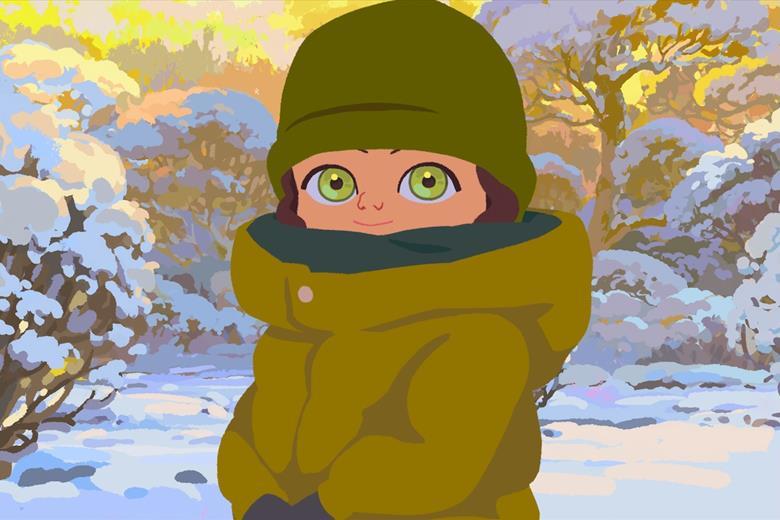
Amélie grows fond of her nanny who reads books to her. The baby’s fave is a storybook with illustrations of yōkai, mythological creatures that can look fearsome. The two also take nature walks together. One day, they meet the landlady out in her garden. The old woman seems disapproving of nanny’s gentle attentiveness to baby. She scowls at the child. Amélie observes: She refused to love me.
How could she not like this sweet child? But nanny knows why. Although she herself suffered greatly as a child during WWII, she is able to look beyond the family’s white/western-ness. Will the old woman’s heart soften?
Innocent Amélie is too innocent to understand prejudice. When she sees her brother flying kites designed to look like carp, she is very interested. Nanny explains that it is for a special day for boys. Baby is indignant. What about girls?!
Japan has become less patriarchal over the past fifty years. Today, the country includes all children in the Shichi-Go-San (7-5-3) Festival. In the old days, babies’ hair was clipped short and at the age of three, the parents let the hair grow out. Before the advent of vaccines and other medical advancements, life was precarious for young children. Reaching the age of three, was an important milestone. The 5th and 7th birthdays also include special prayers.
Last year I was in Japan in late October and while visiting Shinto shrines, I saw families–all dressed traditionally– come to receive blessings from priests. The little children looked extremely cute in kimonos (for girls) and hakone (for boys). But a Japanese person I spoke to said the little children get bored having to pose for pictures. At least they get chitose-ame/ thousand-year-old candy as a reward. It would be pretty cool if the candy was made a millennium ago, but no, the name designates a wish for long life.
Amélie, like all children, is in wonder over much of life. She is especially drawn to water, gravitating to ponds and puddles. One afternoon when it is raining, her nanny tells her that the word that sounds most like the girl’s name, ame, means rain in Japanese. As they crouch by a window, looking out at the rain, nanny traces her finger on the condensation. She writes the kanji symbol for rain and tells Amélie that this is her name. “I became the rain,” she declares.
One day, her parents mention that someday they will return to Belgium, a place Amélie has never been. Je suis Japonaise! She declares that she is Japanese, but her parents tell her that the whole family is Belgian.
Even when the family goes to the sea for a day at the beach, Amélie is preoccupied by her often-melancholy musings. Why do we die she wonders. This girl is smart, but at her age (about 3 yo) she cannot understand the permanence of death. She is sad. She thinks of how her nanny says she loved going to the beach with her family when she was a child– before WWII caused so much suffering. Amélie decides that she will catch the essence of the beach in a jar. She plans to give this to nanny, hoping it will bring her happy memories.
You can watch this movie with children, Amélie’s wonder at the world around her would be relatable, along with her small conflicts with her siblings. The philosophical questions will be unrelatable.
I haven’t read the book, a sort of creative non-fiction of the author’s childhood in Japan. But I began to wonder if the author had suffered from childhood depression.
Another question arose for me; was baby smarter than me? Answer: I guess so.
Don’t let your ego interfere with appreciating Little Amélie. After all, most babies are pretty silly and you can feel superior to them. Well, not in cuteness– they always win that.
Movie Loon’s Movie Review Shortcut:
Grade: A-
Cut to the Chase: Unique. Beautiful animation. Hopeful.
Humor Highlight: The charming grandma.
Categories
 Movie Loon