
Don’t Let’s Go to the Dogs Tonight
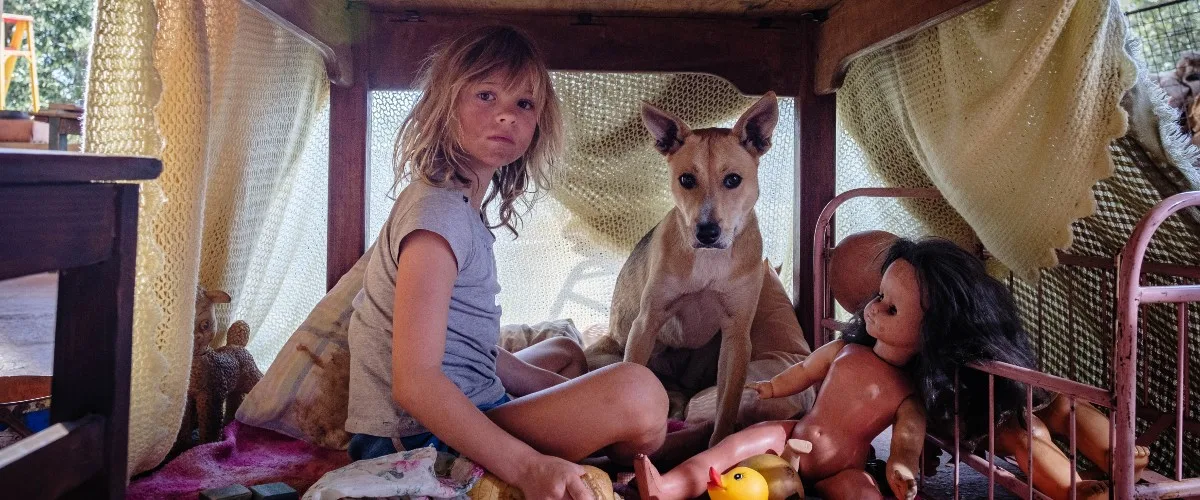
Synopsis: Based on Alexandra Fuller’s memoir recounting her childhood in Rhodesia-Zimbabwe during the Rhodesian Civil War in the late 1970’s.
Many kids would choose spending their days in perpetual summer vacation rather than heading back to school rooms. And I don’t mean the current kind of summer vacay with organized activities, including summer tutoring. How about an old-timey kind in which kids are left to their own devices? Hanging around the house doing nothing and exploring outside.
Eight-year-old Alexandra, nicknamed Bobo (Lexi Venter), has that life. She and her white family are colonists who live on a cattle farm in Rhodesia. It’s 1980, so no cellphone. I don’t think the family even has a landline. They manage the farm and hire Black labor.
When Bobo is in the house, she checks out what her mom, dad and sister are up to. Sister Van (Anina Reed) is a teen and considers Bobo a pest. She likes ABBA and wants to get back to boarding school. Mom, Nicola (Embeth Davidtz), is often sleeping off her latest drinking bout, her rifle in bed beside her. When Bobo wants to spend time with mom, she tells the child to bugger off.
When we meet dad, Tim (Rob van Vuuren), he’s busy stripping and cleaning his rifle on the porch. He’s a member of the local white militia. Bobo follows around housekeeper Sarah (Zikhona Bali ). Sarah is the person who prepares her meals and gets her to bathe. Groundskeeper, Jacob (Fumani Shilubana), warns Sarah that she is putting herself in danger. Rebels who shelter in the nearby hills could see her catering to a white child.
There is a Civil War going on that began in 1964. There has been a white minority government since the 1890’s. Native Black Rhodesian groups are fighting (and infighting) the government forces. It’s 1980 now and there has been widespread violence leading up to the impending election. The white landholders are worried that Communist revolutionary Robert Mugabe will become president and confiscate their land. The Fullers paid for their farm, but it’s the native Black people who, generations before, have been disenfranchised.
The Fuller family and their group of white friends make time to party in between the men’s militia patrols and the women’s volunteer civic duties, like police support. When mom is at home drinking, she gets maudlin and listens to bagpipe music on the record player. But among friends she dances wildly at a makeshift bar. Bobo watches the shenanigans and slips outside to smoke a cig.
Bobo tries to comprehend what is going on. Mostly, though, she zips around on a dirt bike– no helmet, of course. There’s no indication that Bobo has had any formal education. Someday she’ll go to boarding school like her sister. I hope her parents take the time to teach her to read before then. Or at least pay enough attention to realize that their daughter pilfers their cigarettes.
Bobo is feral, so she knows the most about the natural world around her. She explores with the family’s dogs. Suburban dogs would know that kids belong in school or in front of the TV. Still, it’s impressive how she can keep up trotting as part of the dog pack.
Dashing and climbing hither and yon made me worry that Bobo would be killed by wildlife since no one is around to supervise or protect her. Actually, it’s inside the house that wildlife appears. One day, Sarah is screaming in the kitchen. There is a cobra in the pantry. Her screams rouse mom from bed. Mom runs into the kitchen, military rifle in hand. The cobra rises up and flashes their hood. Mom lets loose, spraying the snake with bullets. Ah, just another day at home.
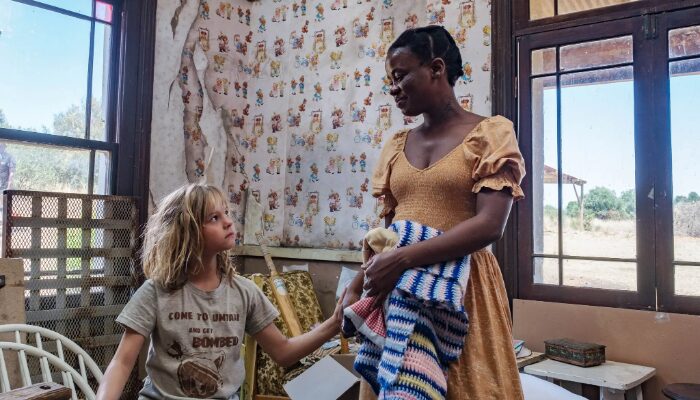
The movie, directed by South African actor Embeth Davidtz, is based on Alexandra Fuller’s memoir. She recounts growing up with hard working, hard living parents. As a child, she can’t comprehend the danger of, or the reasons for, the civil war. What makes the book so searing and poignant is the author’s voice; she spares no pity for herself when she relives an excruciating accident in her childhood. The movie pictures the events of her childhood, but it can’t match the memoir, which isn’t in a child’s voice. Instead, the adult takes an unflinching look back at what she experienced as a child and gets to the heart of what she bears as an adult: loss.
Midway through the movie, Bobo insists to a Black worker on the farm that she is African. “You are not!” he informs her. She’s confused by the rebuke. Later, when she comes upon a family of squatters on the farm who invite her to share food with them, she is wary. Just a child, she can still sense that the balance of power is changing.
When she gets back home, I wanted to tell her to brush her teeth and find a book to read. Bobo’s parents will be too preoccupied to tend to her, and she will have to be ready for a new place. No doubt, the feral child will find her way. Not even boarding school can defeat her.
P.S. Don’t Let’s Go to the Dogs Tonight was filmed in South Africa.
P.P.S. Mugabe’s party won in 1980 and Mugabe became prime minister (title changed to president in 1987). The country’s name was changed to Zimbabwe. His efforts ended white rule. Mugabe’s rule was characterized by land redistribution (from whites to Blacks, including government officials), and genocide of approximately 20,000 Ndebele people in western Zimbabwe. By 2000, the economy had deteriorated, unemployment was at 50%. Mugabe blamed the trouble on homosexuals and the West. He also had 100 elephants killed for a feast.
After the 2008 parliamentary and presidential election, Mugabe’s party was defeated by Morgan Tsvangirai. Mugabe refused to concede and sent his supporters to assault and rape Tsvangirai’s supporters. In response to the violence, Tsvangirai agreed to become Prime Minister while Mugabe remained president. In 2017, following vote-rigging in the last election, Mugagbe lost favor within his own party and was forced to resign. The supposedly communist Mugabe left with millions in business interests. He died in 2019.
P.P.S.S. Beginning in the 19th Century nearly all of the nations in Africa were colonized by European nations. Liberia and Ethiopia being exceptions. As for the state of nations within the African continent in 2025…
The Human Development Index (measures health, education and income) ranks Seychelles #1, followed by Mauritius, Libya, Algeria and Tunisia. The Human Rights and Rule of Law Index places Cabo Verde first, followed by Namibia, São Tomé and Principe, Mauritius and Ghana.
Movie Loon’s Movie Review Shortcut:
Grade: B+
Cut to the Chase: Lexi Venter, as Bobo, is amazing. Naturalistic and thoughtful. Liked the movie, loved the book.
Humor Highlight: When the white mom tells her mother’s maid who to vote for in the upcoming election… because their interests are so the same.
Categories
 Movie Loon