
A Real Pain

Synopsis: Cousins go to Poland to visit the village of their Holocaust-survivor grandmother. The two guys bond and bicker.
Behold the group tour and its age-old rules… the tour guide, accepted as group leader, should be knowledgeable & affable while the group members are agreeable and eager. It doesn’t matter if it’s a present-day tour of the Roman Forum or a long ago pilgrimage a la The Canterbury Tales; la plus ça change, plus c’est la meme chose/ the more things change, the more they remain the same. I think that famous French teenager Joan of Arc said this after finding herself in front of the English on heresy charges. (Or maybe 19th Century French writer Jean-Baptiste Alphonse Karr.)
I myself have been on tours that deviated from expectations. I was once on a walking tour in Bruges dedicated to the consumption of chocolate. An older couple insisted they didn’t know walking would be involved. And, they asked the guide, could they get a cab and pay in US dollars? Sure, if it was 1950.
Another time, I was touring Pompeii with a guide named Enzo who clearly hated all tourists. Someone asked him if there were reports of ghosts in the area. This question made Enzo tremble with rage. He managed to spit out a No, before abruptly turning away from his charge, lest he strangle him to death. I could’ve cleared the whole thing up. Ghosts only haunt a place for a few hundred years max. Anyone who thinks ghosts would still be hanging around Pompeii after nearly two thousand years is foolish.
In A Real Pain, New York cousins David and Benji Kaplan embark on a trip to Poland where they will join a Jewish heritage group tour. Their Grandmother Dory was a Holocaust survivor, and they plan on taking a side trip to her village. She recently passed and her will included funds for her two grandsons’ trip.
David (Jesse Eisenberg) and Benji (Kieran Culkin) meet up to fly out of New York to Warsaw, Poland. David is nervous about the travel machinations while Benji is nonchalant. He had just been hanging out at the airport people watching. Benji offers David a yogurt that he had squirreled away in his pants’ pocket; David demurs.
We quickly learn that David has his life together, with a place in Brooklyn, a job in digital ads, and a wife and kid. Benji, rich in slacker charm, is single and childless . No word on how he supports himself in upstate New York, but he does have enough money for weed, which he assures David he’ll have waiting for them at the hotel in Krakow. David gulps and avers that recreational cannabis is probably not legal in Poland. Benji smiles and shrugs.
They’re attached by childhood bonds, but certainly have disparate personalities and outlooks. David is more reserved and conscious of protocol, while Benji quickly engages with people and throws propriety out the window. It seems whatever continent Benji’s on, he’s on his own plane of existence.
Once at the hotel, the travelers converge on the lobby to meet their tour guide, a pensive British man named James (Will Sharpe of The White Lotus, season 2). James tells the group about his educational background and what they’ll be seeing on the tour.
Everyone introduces themselves: recently divorced Marcia (Jennifer Grey), convert to Judaism, Rwandan Eloge (Kurt Egyiawan) and an older couple from Ohio, Diane (Liza Sadovy) and Mark (Daniel Oreskes). Except for Eloge, they have Jewish relatives who were subjected to the Holocaust.
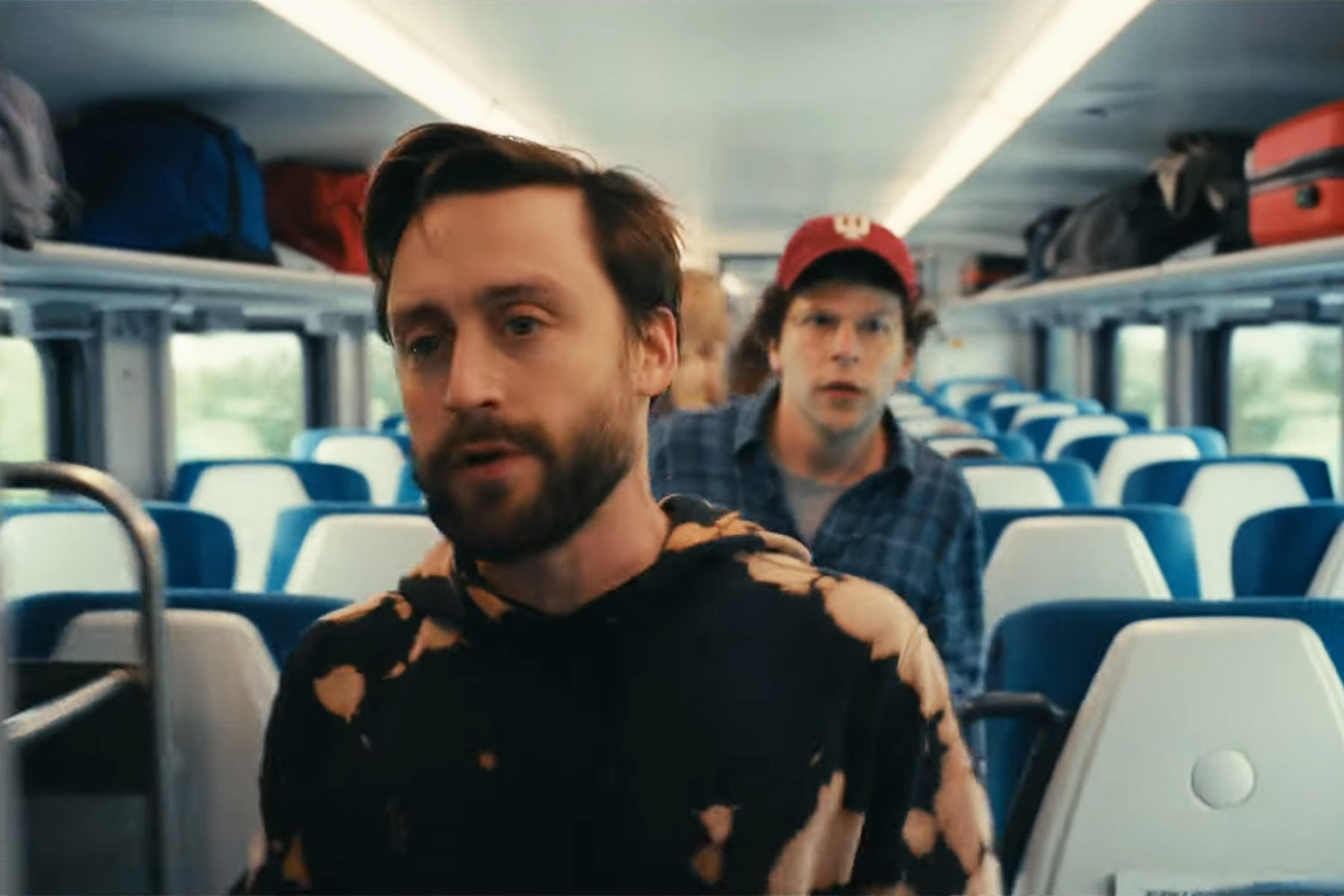
As for the group tour; so far, so good. Sure, during introductions, Benji was a little flaky and sweary, but so what? They all have a common bond and the tour guide seems experienced.
The group starts with a walking tour through Warsaw where they visit the Warsaw Ghetto Uprising Memorial and the former ghetto area. All sad and important. It made me wonder how people decide to comport themselves on a remembrance tour. The reverence would be genuine, certainly. But you are out exploring some pretty neighborhoods and stopping at cafes… what if you start laughing with a group member about some celebrity gossip or something while the rest of the group is soberly considering the immiseration of Warsaw’s Jewish population circa 1940? I mean you shouldn’t actually seem like you are enjoying yourself because then it looks like you are a callous person, maybe even an antisemite–even if you are, in fact, Jewish. But maybe having a good time is the way to show those Nazis that, ultimately, the Allied forces won and they lost. We’re the ones having fun now.
At another memorial, Benji really pushes the envelope on how to behave on the tour. The over-sized human statue forms are soldiers, frozen in action, liberating the city in 1945. Benji asks David to take a pic of him posing in front of the memorial. David says he’s not sure, but it might be disrespectful. Before you know it, Benji has smilingly waved over the other group members.
If you think that Benji, charming and disarmingly open, is a spotlight hog, you’d be right. He’s quick to play piano at a bar and make friends with quietly sexy Marcia, but when his mood turns dark, he subjects the whole group to his diatribes. In a first-class coach, Benji insists they have no right to enjoy such comfort when their own people were herded into cattle cars during the Shoah.
Okay, group tour protocol violated. The tourists are expected to be non-confrontational with each other. Everyone looks at each other awkwardly. Benji stalks off to find the coaches of the populace. David apologizes on behalf of Benji and rushes off after him, bringing along his forgotten lunch. I’m pretty sure that Benji would be offended that David apologized for what?! And he might even refuse the first-class lunch.
David and Benji do fine, alone together smoking weed on the hotel roof or visiting a market where Benji gets a silly hat, because of course Benji wants an anachronistic folk hat. David indulges Benji when he’s in a good mood and tries to steer him away from uncomfortable scenes from childhood where Benji insists David was more real, more ready to cry.
Speaking of keeping it real; another tour group violation by Benji. He usurps the amiable authority of the tour guide. As the group members study gravestones in an old Jewish cemetery, our resident imp gets vexed by inoffensive tour guide James, or Jimothy, as Benji calls him. Jimothy had the temerity to be quietly telling one of the group about the history of the man whose gravestone they were reading. Benji informs him that he is not keeping things real, because these were real people and he needs to respect that. He further protests that they are just going around like tourists, touring places. In his defense, James explains that tours typically revolve around touring.
In between bouts of goodwill, Benji seems to be coming undone. David is getting more aggravated about having to basically babysit his grown-ass cousin.
Soon we’ll learn something about Benji’s recent past that suggests the last thing he needs is a wrenching tour remembering the murders of millions of innocent people. And we haven’t even gotten to Majdanek, the death camp in Lublin. Horrifically, the Nazis built a giant ring of death camps near Warsaw: Sobibor, Treblinka, Belzec, Auschwitz-Birkenau and Chelmno.
The tour guide and fellow travelers do have a reprieve coming. Benji and David planned to leave the tour early to take a detour to their grandmother’s village, hoping to find her old apartment building. Speaking no Polish, they’ll really be on their own. Hopefully, they will still have some weed left to chill at the end of the day.
For everyone on the tour there is sadness to grapple with, and with sympathy, they accommodate Benji. After all, all of the victims of the Holocaust were made up of individuals who were living with their own pains and loves.
P.S. Shoah (1985) stands as the ultimate documentary of the Holocaust, or “Shoah” in Hebrew. Over nine hours the truth of the atrocities are documented in interviews with survivors, witnesses and perpetrators.
Worldwide, 2025 has seen the rise of right-wing totalitarian regimes. In addition to documentary films recording the truth of oppressions, past and current, narrative films also play an important part in sensitizing people to individuals in out-of-power groups being victimized by in-power groups.
A Real Pain, shows coverage of the characters/actors bearing witness at Majdanek, a Polish concentration camp. The goal of the Polish camps was to kill all of the Polish Jewry. Between 1941- 45, the camp’s prisoners supplied slave labor, while others were quickly murdered. Research in 2005 indicated that at least 79,000 people were killed, some by disease, abuse, most by gassing with a cyanide-based pesticide, others by firing squad. An estimated 59,000 of those killed were Jewish. Figures cited in the Holocaust Encyclopedia put the figure closer to 100,000 victims.
Today, the camp grounds and memorial are open to public tours. Among the exhibits is “The Primer” or “Elementarz.” It is dedicated to the children who were murdered at Majdanek. One of the murder victims was nine-year-old Henio Zytomirski born to a Polish Jewish family.
 Movie Loon