
The Taste of Things
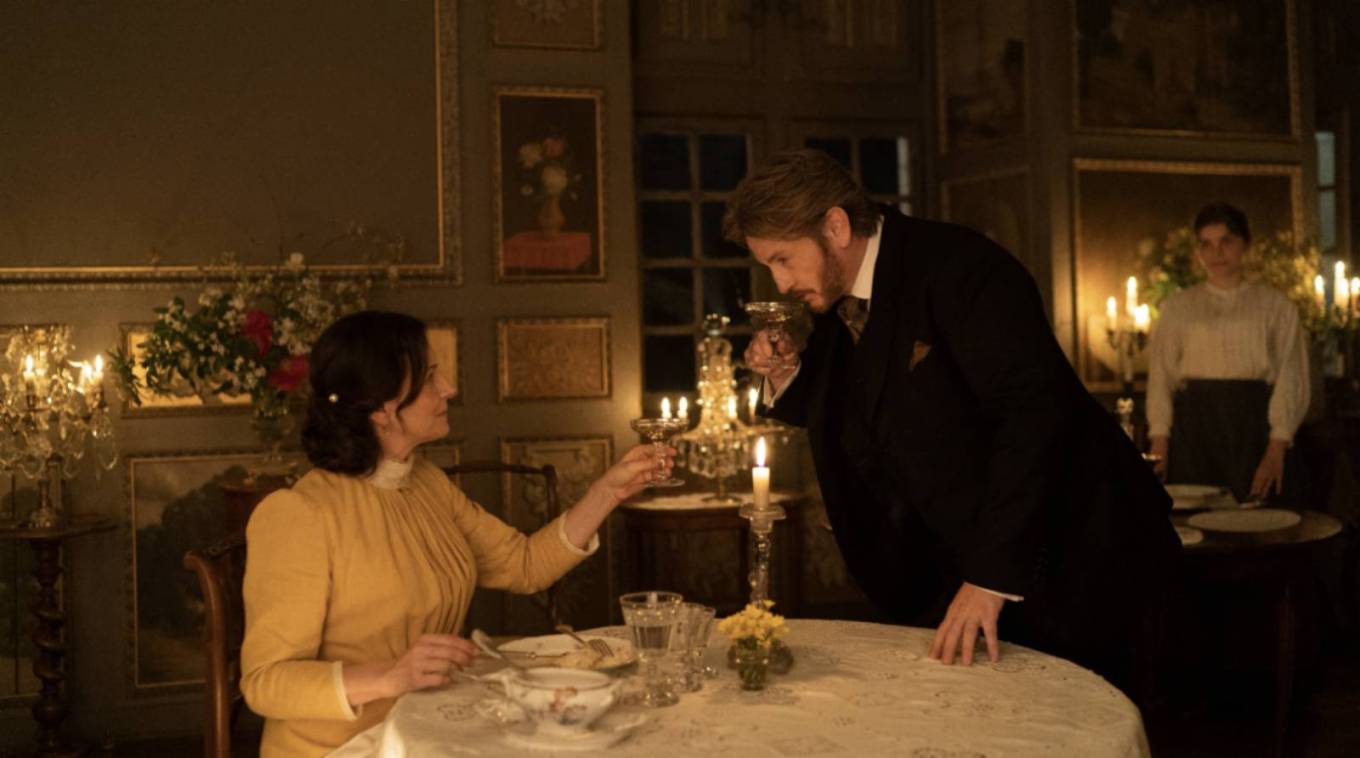
Synopsis: In 1889 France, a food-lover and his chef perfect cuisine. And maybe they love each other. (Streaming on Amazon)
How did the French get to haute cuisine? I mean you don’t just get to Crêpes Suzette overnight. Presumably, thousands of years ago, land inhabitants of present-day France hunted and gathered just as people around the globe did. At some point fire was discovered. Maybe someone accidentally dropped a chunk of meat into the campfire. Calories were hard to come by, so after fishing out the sizzling meat and letting it cool, they ate it. I guess it was better than the raw stuff, because shish kabobing meats started trending.
Got a heat-proof vessel? Toss whatever your group has hunted and gathered that day into the dish and hang it over a fire. Voila! The first pot-au -feu, France’s national dish.
The Taste of Things vaults to France in 1889 where a chef, Eugenie (Juliette Binoche) puts her magnificent signature on French cuisine for her baron employer, Dodin Bouffant (Benoît Magimel), a renowned gourmet.
The film begins with Eugenie plucking veggies from an extensive jardin. A long cooking sequence in the manor’s kitchen follows. Imagine an old-fashioned cooking show where contestants are not charged with creating dishes at breakneck speed. We watch as everything is prepared with great deliberation.
I was okay with there being no recipes jotted onto the screen because the chef and her assistant were doing gruesome things like cooking fowl with their feet still attached and pushing marrow out of cow’s bones. Not for me! At one point, Eugenie takes an entire skate fish–which looks like a stingray with two eyes plonked together on what looks like a fin– and heaves its body into a tureen to cook. Later, she’ll peel away its skin. Eeesh…
Juliette Binoche looks quite fetching as she cooks with a monk’s serene concentration, her face dewy and flushed from the kitchen’s steaming dishes. Whenever Dodin samples the dishes, he blisses out, saying things like “The consommé is gentle.”
Eugenie is preparing dinner for monsieur and a small group of his friends, gourmands who seem to do nothing in life but eat with great appreciation. As they dine, with dish after exquisite dish being presented for their pleasure, they philosophize. Philosophizing while dining? Is this a French thing? “Man is the only animal who drinks without thirst,” declares one fellow. Not true. I have seen many a cat drinking tuna broth like it is fine wine.
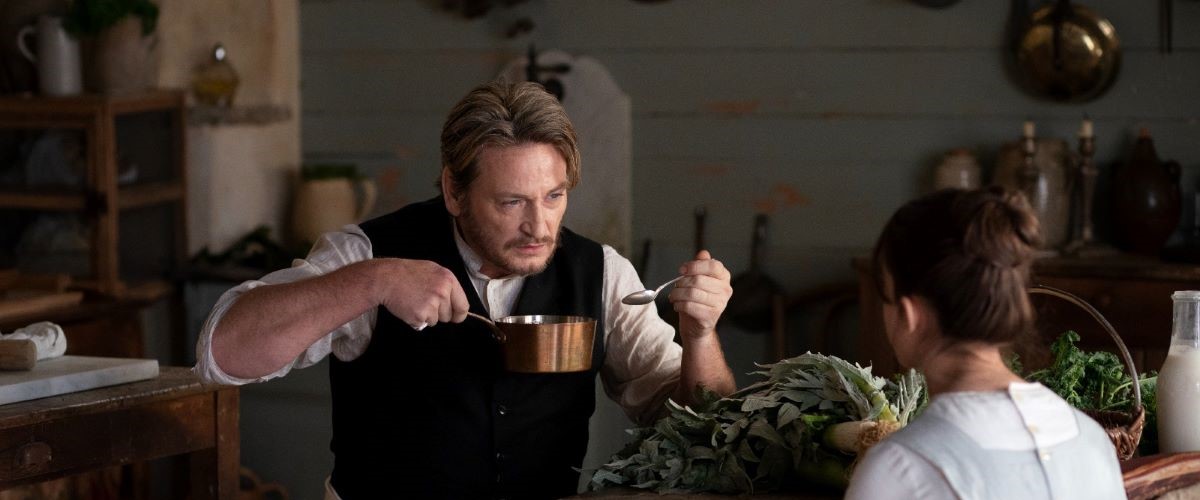
So, what seems like an hour goes by, before a potential plot develops. A girl, Pauline (Bonnie Chagneau), from a nearby farm has come to–possibly– apprentice in the kitchen. She is some sort of Palate Prodigy. When she is asked to weigh in on some of the completed dishes, she identifies about thirty different ingredients by taste alone. Mon Dieu! The girl is fascinated by cooking, but her loving parents say she is too young to live at the manor with her teen relative Violette (Galatea Bellugi) who also helps Eugenie in the kitchen with cooking whole animal carcasses in bottles of wine.
Meanwhile Dodin meanders, declaring, “One cannot be a gourmet before forty.” But evangelizing about haute cuisine is not all he does; he also romances Eugenie. She loves him, but resists his proposals because she is an independent woman who does not want to lose her identity as a chef.
This made me hark back to Chocolat where, nearly twenty-five years ago, Juliette Binoche played a chocolatier who was being romanced by a vagabond. I really liked watching her make pralines and bonbons– no slaughtering needed to prepare these delicacies. Anyway, this brings me to my gossipy ears being pricked when I learned that the two leads, Binoche and Magimel used to be married. So very French that they can go on to creating art together, years after their divorce.
All this cooking finally got me hungry when Eugenie makes what looks like a Baked Alaska. Oh, joy; it is! I thought this dessert was created by some cruise ship chef in the 1970s- We’ll light the ice cream on fire to satisfy the tourists. Dodin waxed on about how Balzac had created this enflamed delight. Wow… I was impressed that the famed French novelist and playwright was so multifaceted! Alas, not the same Balzac who created what the French call Omelette Norvégienne (Norwegian Omelette). I like Bombe Alaska better.
There is lots of cooking and little talking. My North American mind started to wander… and I began to hanker for an episode of Is it Cake? This is a dumb, but mostly inoffensive show wherein bakers make cakes that look like everyday objects such as shoes and cash registers. Then the judges, from a distance, have to determine which shoes are real and which are cake. There is much banter and laughter too.
I wanted the movie to speed up and develop a plot. What’s this? Dodin may develop a menu to serve to a visiting prince and Eugenie will execute such. He feels that pot-au-feu may be the quintessential French dish to serve. Better than what they had earlier in the movie–brace yourself. There is –was– a dish called ortolans which involved netting songbirds, keeping them in a cellar, force feeding them grain and then drowning them in booze. What the hell kind of sadist came up with that? Fortunately, the dish is essentially outlawed because the poor birds’ population plummeted. You can see why I was thinking of cake instead.
The Taste of Things plods along at a tasteful crawl. I give the film credit for showing the passion of French gourmets and chefs who created and appreciated the terroir of France and its epicurean possibilities.
So how did the French get to haute cuisine? Apparently, traditional French foodstuffs were made sophisticated by chefs for royalty in the 1700’s. Then the non-royals made their discontent known and overthrew the monarchy in 1789. Maybe they were mad about Marie Antoinette telling them to eat cake if they had no bread. Yeah, she really couldn’t read the room.
During The Taste of Things, Dodin breathlessly waxes on about early 1800’s chef Marie-Antoine Carême’s genius. Carême wrote volumes on emergent haute cuisine, codifying a wealth of “mother sauces” like béchamel and allemand. He was also a kickass pâtissier, creating Greek temples and the like from choux pastry and sugar. Mostly importantly, he designed the chef’s toque.
Post-dating the film, Auguste Escoffier would bring haute cuisine to new heights by establishing the brigade de cuisine (highly organized kitchen staffs) and created famous dishes such as Filets de Sole Coquelin and Pêche Melba.
The Taste of Things is an homage to French cuisine, blending Nature’s bounty into subtle and flavorful dishes. But the jury is out on what is most satisfying for humans to enslob themselves on…
Americans may have cracked the code by flavoring fat and salt along with flavoring fat and sugar to create junk food people can’t stop eating. Doritos and Oreos are some of the best examples. But a movie showing factory production and people stuffing themselves in front of the telly wouldn’t be as pretty.
P.S. The Taste of Things was France’s entry for Best International Feature Film (2023). The brilliant Anatomy of a Fall was passed over. Read the review here
P.S.S. A typical recipe for the stew pot au feu includes cuts of beef, onion, leeks, celery, carrots, potatoes, parsnips, rutabagas, parsley, thyme, bay, pepper & whole grain mustard.
P.P.S.S Baked Alaska is an assembled dessert: a layer of sponge cake, covered with a dome of ice cream, covered with whipped meringue & then quickly baked or set alight to carmelize the meringue. Yum.
 Movie Loon