
Train Dreams
Synopsis: The story of a man’s life in the early 1900’s Pacific Northwest. While working as a logger his life yields losses and rewards.
Ah, beautiful wilderness. Robert Granier (Joel Edgerton) lives in forested Idaho in the early 1900’s. He came to the area as a boy, orphaned and transported by train to guardians. The mute, ancient trees radiate peacefulness. As the decades go by, the millions of acres of forest in the Pacific Northwest are felled for lumber. Today, more than seventy percent of the Old Growth conifer forests are gone.
Train Dreams, based on the novella by Denis Johnson, follows Robert’s life in the Pacific Northwest. As an adult, there are times in which he chooses to seclude himself in a wooded area. Sometimes he hears voices or experiences hallucinations. Is it a result of his isolation? Or is it a spiritual experience?
Have you ever heard of Prairie Madness? It begins with The Homestead Act of 1862 which offered Americans free land out West, stolen from Natives. Settlers had to farm the land over five years in order to earn a deed/patent. In the early years, the settlers went into the Great Plains.
The whites lived precariously on isolated family farms. The beautiful Great Plains with grasses that stretched as far as the eye could see presented a forlorn and overwhelming environment to many people who came from the more populated, hilly and forested states in the East.
The Indians who had lived on the Great Plains were mostly nomadic, traveling in tribal groups. They didn’t go mad because their groups were large enough to offer the members social care and cooperative hunting and foraging as a guard against hunger. And they already had an ancestral comfort in the plains.
Characteristics of Prairie Madness were depression, anxiety and even violence. In the winter, the silence could be profound, otherwise the wind raged. In 1893, journalist Eugene Smalley wrote “The Isolation of Life on Prairie Farms” for The Atlantic. He reported that “An alarming amount of insanity occurs in the new prairie States (sic) among farmers and their wives.”
The bison and prairie dogs had the right idea; gathered together in great stampedes or excavating tunnels to compose miles of towns. Just to be clear, it’s the bison stampeding and the prairie dogs popping up from burrows.
All of this is to say that I wondered if Robert Grainier would go mad in the wilderness. Although, as time goes by, there is less of nature in which to lose oneself.
Like all people without a trust fund or lottery winnings, Robert has to make a living in the environment in which he finds himself.
As a young man, he becomes a logger. In the summer the ‘cut’ crews would clearcut through untold acres of old-growth forest, resplendent with Douglas Fir growing to over 300′ and Western Red Cedars with trunks 15′ in diameter.
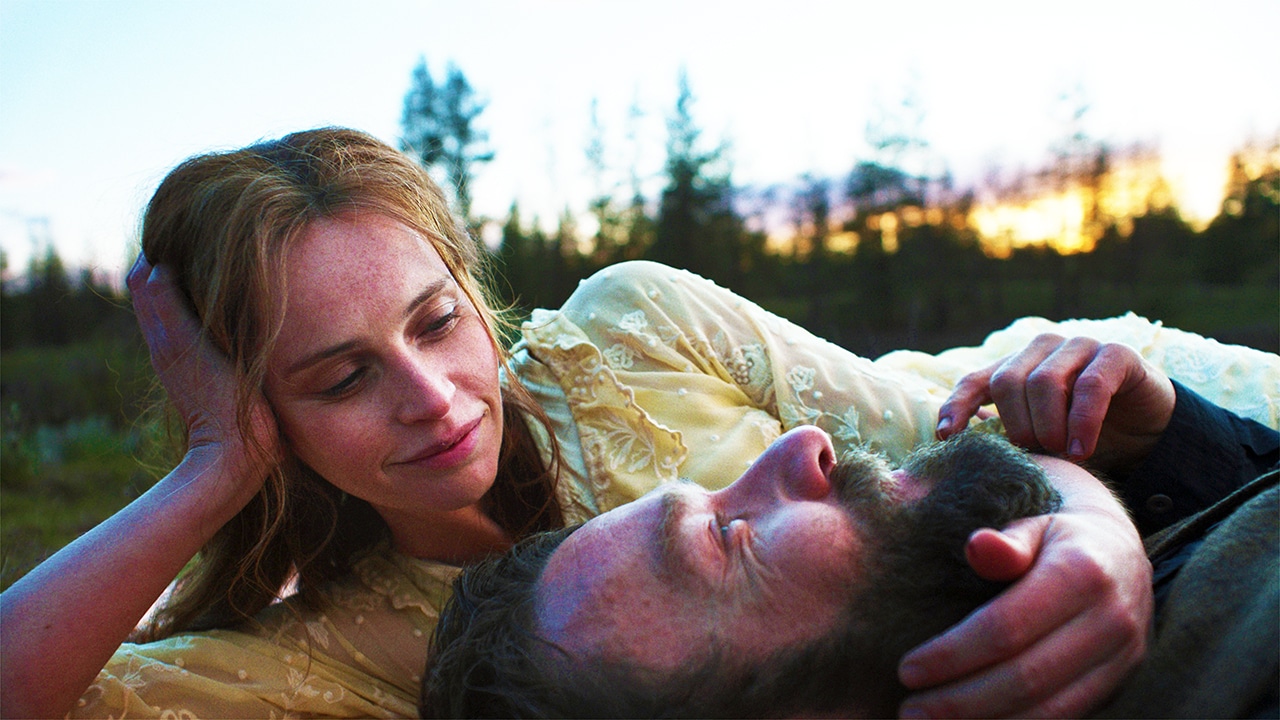
Robert, quiet and even-tempered, hovers around a small town in Idaho in the off-season, picking up work when he can. At church he meets Gladys (Felicity Jones), and keeps showing up at services, hoping to court her. She is gentle and pragmatic, seemingly at home in town or in the countryside. They fall in love and marry. The couple loll around in the grasses as Gladys sensually strokes Robert’s luxuriant, lice-free beard. Lost in each other’s eyes, I thought Watch out for bears!
At the time, circa 1916, grizzly bears were not such rarely seen beasts out West. Just ten years later grizzlies would be extirpated in California. Today in Idaho, there is a small, federally endangered population that roams in the Selkirk Mountains. People should still watch out for bears though. To be fair to the bears, historically, they’ve been the ones hunted down by people in great numbers.
Robert encounters all manner of men in the logging camps. There’s Bible Guy, who talks all the time about guess what. Even the exertion of crosscutting doesn’t quiet him. Bible Guy loudly announces, “The Lord told me to go to Omaha!”
Arn (William H. Macy) is a feature in the camp each season. He talks all the time too. He’s the explosives expert and, as an old man, does the non-taxing work. After talking all day, he sings at night from his tent. Some guys yell at him to STOP. Chastened, he fishes a harmonica out of his stuff and begins playing. Maybe all his noise-making will keep bears out of camp. Actually, all of the forest creatures probably fled when the crews came in and started cutting.
One night at the campfire, some young sawyer enthuses that they’ll never run out of trees to cut. He maintains that after a thousand years they might get to the end and then just start all over again. I wanted to appear in the story and tell this fool that once flora and fauna are put into humans’ commercial system, their bio representation on the earth will plunge. I’d mention that old forests are better carbon sinks and better resist fire than young forests. But he’d just call me a fool-woman or maybe a dumb city slicker.
Well, I warrant that people do anything and everything to survive/make money. But old Arn speaks wisely to the men around the campfire, and Robert listens. Arn acknowledges that he thought the same thing decades ago, that there would always be trees for cutting. And then Arn soberly avers that their work is rough on a soul, taking the lives of these giants that had existed for hundreds of years.
The beauty of the surrounding land hovers, but the loggers camp in the beaten, scarred land left after felling hundreds of trees a day. Violence is swift, from falling limbs and runaway logs. And violence from other men. He sees how quick a group of white men are to accuse and beat an Asian laborer. Robert can’t wait to collect his money and get back to his wife Gladys and their baby girl, Katie.
The couple are overjoyed when reunited. Robert is amazed at how their daughter has grown. They picnic by the creek. It’s like they’re actually trying to draw bears to them!
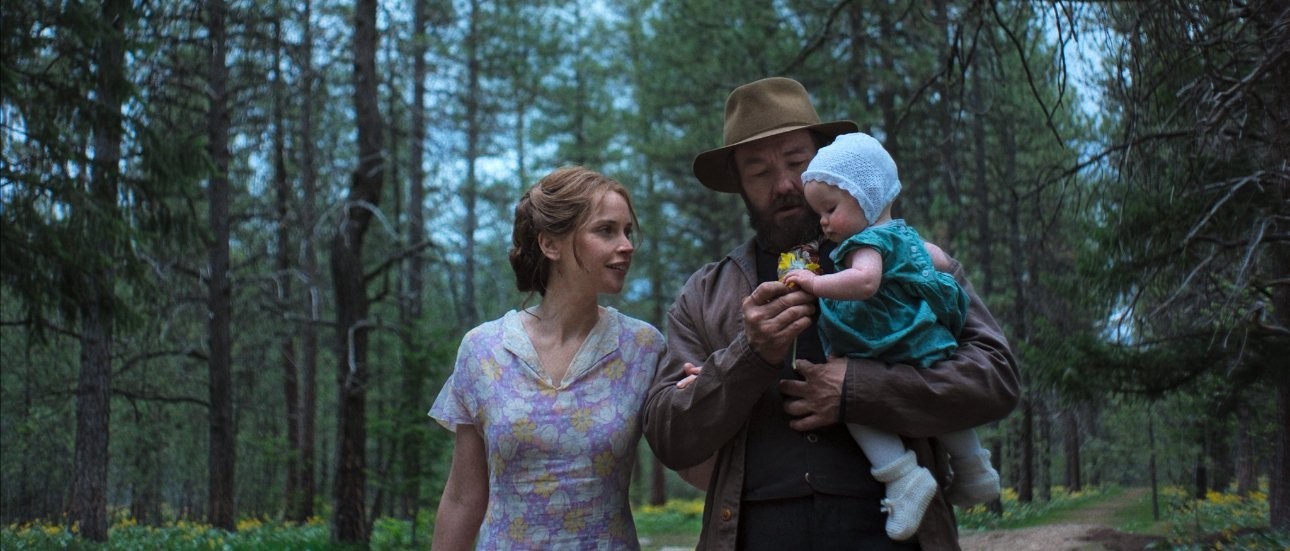
As the couple watch the baby play, Gladys tells Robert that she’d like a dog. They ponder how smart a dog is versus a baby. If only they could see today’s videos of border collies demonstrating their knowledge of the names of a hundred objects. Meanwhile, child development experts inform us that babies don’t know their own names until they are six months old. So embarrassing for the babies.
Work in town is tough to come by. Robert buys necessities from the Native American store owner Ignatius Jack (Nathaniel Arcand), a sympathetic man who offers him food when times are tough.
Robert braces himself for another season of lumberjacking. Gladys considers possibilities that could keep the family together. Maybe they could build up a farm. Or she and the baby could follow the cut. Robert says that’s too dangerous. I felt sad for the little family. And who knew what bad luck might befall them when separated.
Train Dreams follows Robert into old age. He’s had to quit logging. I think the final straw was when some young whippersnapper pushed him aside as he was trying to start a newfangled motorized chainsaw: Move, Old Man!
Robert goes through a long period of living on his own, subsisting on foraged plants and fishing. He doesn’t take care of his beard. He bathes in the creek. Do you know who else likes to splash through creeks? That’s right, the mighty ursines of our planet.
And then it happens… Robert and a grizzly cross paths. I caught my breath as they regarded each other. I thought of how Leo DiCaprio was mauled by that CGI bear in The Revenant. Like all mother bears, she thought he was after her cubs.
The bear walks on! But not before giving Robert a look like: Life is hard on all of us. We’ll let each other be for today. Or maybe bear had a headache and wasn’t up to attacking the man.
And that’s how Train Dreams is, full of quietly heartbreaking moments. As he ages, Robert sometimes sees and hears people in the forest. Madness brought on by isolation and a heavy heart? Or a glimpse beyond the here and now?
P.S. I will leave you with the words of Anne LaBastille, a mid-20th Century woman who described herself as a part-time hermit. She was an ecologist and conservationist who earned her PhD from Cornell University. She wrote the book series Woodswoman about her secluded life in the Adirondacks. She was a loner, but enjoyed the companionship of her german shepherd dogs.
The following quotes make me think of our minds, our spirits and our inextricable ties to biophilia–including bears, of course.
“The first trees I got to know, and later drew strength from, were the mature, towering red spruces and white pines.”
“Sometimes I sat in my log cabin as in a cocoon sheltered by swaying spruces from the outside world… Life seems to have no beginning and no ending.”
 Movie Loon