Nouvelle Vague
Synopsis: A recreation of the shooting of Jean-Luc Godard’s New Wave classic, Breathless/ À bout de souffle.
I’m not sure if Richard Linklater’s Nouvelle Vague is art imitating life or life imitating art. What is certain is that the film Breathless (1959) and the French movement that it’s a part of, New Wave, were a breakaway from what came before.
Linklater recreates the Breathless shoot and the behind-the-scenes action with Guillaume Marbeck as director Jean-Luc Godard, and Zoey Deutch and Aubry Dullin as the Breathless‘ stars, Jean Seberg (Patricia in the movie’s script) and Jean- Paul Belmondo (as the character Michel).
Film Noir of the 40’s brought excitement into cinema in a way that theater couldn’t. The 50’s brought more naturalistic performances from actors –think Deborah Kerr and Marlon Brando. Heading into the 60’s, it was time for a change.
French New Wave/ Nouvelle Vague arose in the late 50’s, with filmmakers engaging in experimentation with camera work and editing– a sort of guerilla film shoot. Its stories emphasized gritty realism.
Beginning with Agnès Varda’s La Pointe Courte (1955) and egged on by film critics at Cahiers du cinéma the movement took off. Interestingly, a number of critics from the film magazine went into directing; most famously, François Truffaut.
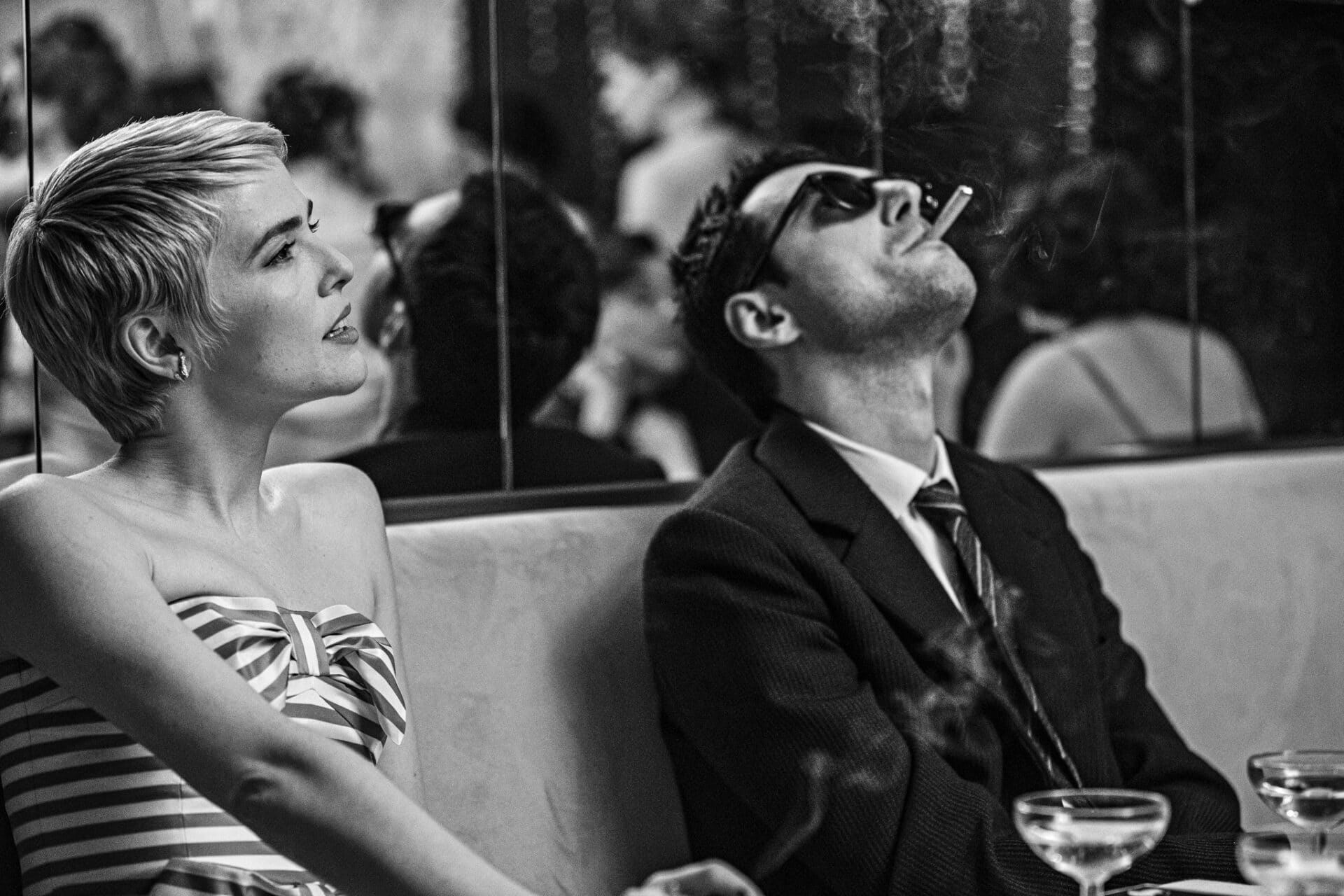
Nouvelle Vague (shot in black and white like Breathless) begins with Jean-Luc Godard and other critics at a cinema taking in a film. They are the late 50’s version of hipster geeks.
Following the film, the cinéistes converge at a party. Godard expounds on what should be happening in film. This monsieur could be described as pretentious with his pronouncements and habit of always wearing sunglasses. But his enthusiasms are real and, as we’ll see, so is his talent.
Godard treks to Cannes for the premiere of Truffaut’s The 400 Blows/Les quatre cents coups. Energized by the film, he vows to become a feature film director. He talks with his former colleague, Truffaut, and becomes interested in filming a treatment of an idea by Truffaut. Godard secures funding, which will be the beginning of the producer Georges de Beauregard’s (Bruno Dreyfürst) angina having to deal with Godard, le artiste.
Godard meets up with actor Jean-Paul Belmondo as he trains for boxing at a gym. Belmondo previously starred in a short by Godard. Belmondo has a mien that is perfect for his anti-hero character, a criminal on the run. Godard tells the actor that, “Your character will die or get the girl.” Belmondo grins and tells him, “I can do both.” Against his agent’s advice, he takes the role, figuring the experience will be fun, if nothing else.
As for the American girlfriend, Godard had his eye on Jean Seberg who had made a name for herself in Otto Preminger’s Saint Joan. Sylph-like, she represented a more modern woman; independent and adventurous.
Filming will begin in Paris, August 1959.
Godard hires cameraman Raoul Coutard who shot war footage in Vietnam. In Godard’s film he will shoot on the run, without artificially-lit sets. To keep actors in the moment, the director didn’t schedule any rehearsals.
Sounds like a mess right? Well, that’s what Godard wanted. He declared that film was “intellectual and moral anarchy.” Some days he jettisoned the script or didn’t work at all, waiting for inspiration. The producer, aka Beau-Beau, can only finance a month or so of production. Many days, he’s reduced to tracking down Godard as though he’s a school truant. In fact, one day Godard basically calls in sick, then goes to play pinball. Beau-Beau, a hefty middle-aged man, ends up wrestling Godard out of sheer frustration. Godard stays cool, a cocky weirdo through and through. Never letting his sunglasses slip.
Some working days the actors loiter, dancing to pass the time. Everyone smokes like crazy as though they are in a race to see who can get lung cancer first. Some days, they actually shoot a lot of footage.
Nouvelle Vague manages to capture the excitement and spur-of-the-moment ethos of the New Wave. The shoot feels fresh–more like film students experimenting and going for broke than a by-the-numbers corporatized production. What a way to work. Especially when the finished product receives heaps of glory.
And now… a note on sexism in films…
Breathless, like movies in most of the 20th Century, belongs to men. Patricia is the girl and Michel is the action. Seberg’s Patricia has a new look for the male gaze. Not exactly progress.
The first movie & character that springs to mind of a woman depicted as driving the action and– importantly–not having to be sexually appealing to straight men is Sigourney Weaver as Ridley in Alien (1979). No cute pixie haircut or New York Herald Tribune sweater à la Patricia in Breathless.
Linklater’s take on New Wave cinema is nearly flawless in its nostalgic ethos. But, like his bozo-ish Everybody Wants Some!! (2016), Nouvelle Vague is a man’s world where women are sexually appealing counterparts. I’m not saying this wasn’t the predominant cinema view in 1959 or circa 1980 Texas where EWS‘s college boys dwell. But it’s 2025 now and all filmmakers, regardless of gender, might be expected to be more enlightened about POVs –not replicating a male-centric view.
We do see director Agnes Varda and Breathless’ editor Cécile Decugis getting screen time. And, to be fair to Linklater, his collaborations with Julie Delpy and Patricia Arquette have given women’s stories equal space. In Nouvelle Vague, the script was written by what turned out to be the fruitful trio of Holly Gent, Michèle Pétin and Vincent Palmo Jr.
So….
Before Nouvelle Vague begins we know that the 23-day shoot for Breathless will result in one of the New Wave’s most heralded works.
The thought of young idealists starting a movement that gets the Western world’s attention is exciting. Today’s hipster geeks might be more likely to spend their time remarking on the ascendencies of various coffee shops. But I’m betting that a fair number of hipster geeks out there are women who are working on artistic breakthroughs, weaving life and art together. Sunglasses optional.
Movie Loon’s Movie Review Shortcut:
Grade: A-
Cut to the Chase: A stylish and coherent look at the French Wave in cinema.
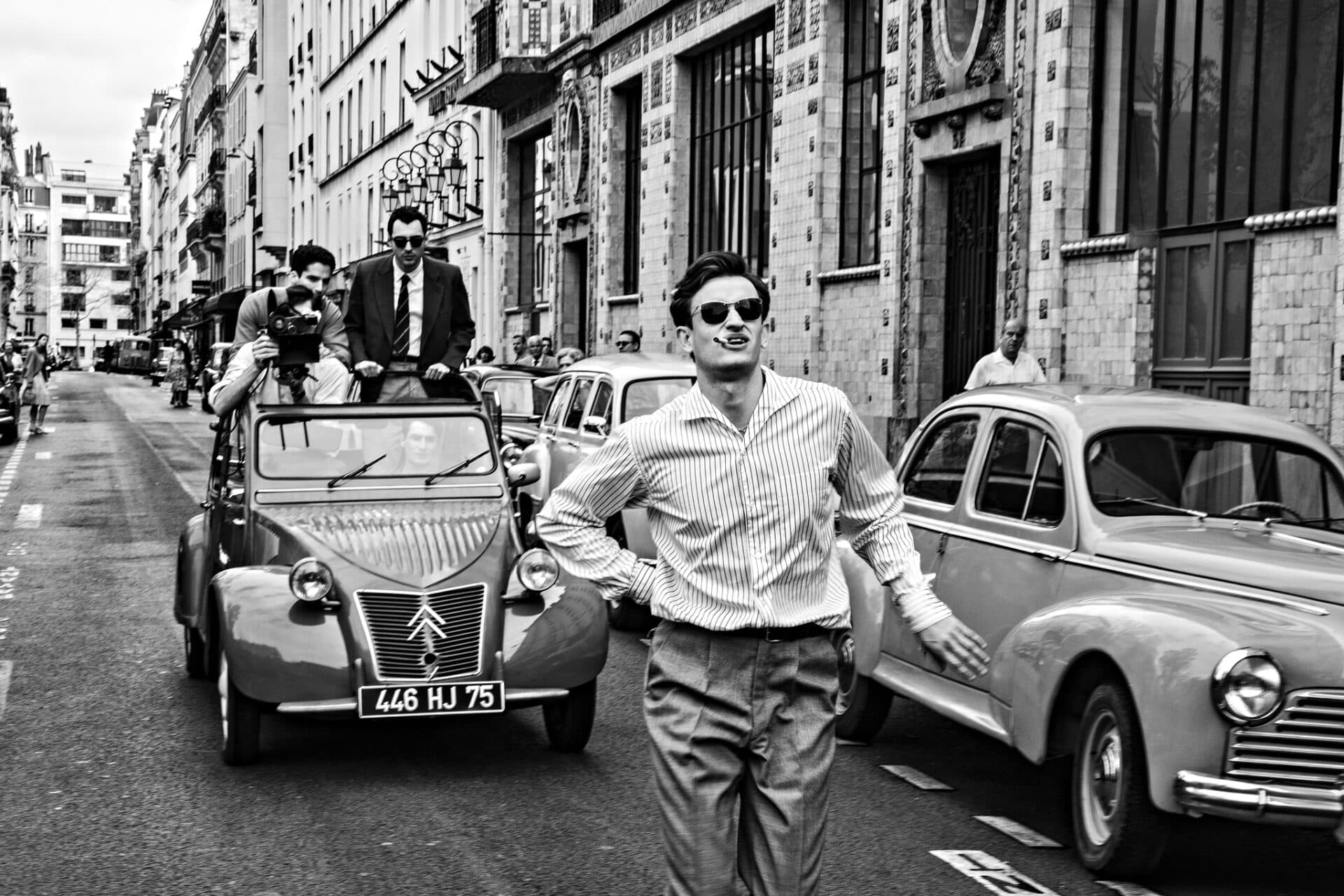
Humor Highlight: Aubry Dullin as Jean-Paul Belmondo as Michel run-staggers down the middle of a Parisian street reassuring bystanders that he’s not mortally wounded, just shooting a film.
Categories
 Movie Loon