
Pangolin: Kulu’s Journey
:max_bytes(150000):strip_icc():focal(749x0:751x2):format(webp)/Pangolin-Kulus-Journey-032125-tout-55dc4ee1bb3844b0b7bd4127bd0ef2a7.jpg)
Synopsis: A wildlife rehabilitation specialist guides a pangolin, rescued from traffickers, back into a wild life. (Documentary)
Our species, modern humans, have been on Earth for about 160,000 years. Starting out, we walked from place to place, foraging and hunting, and seeking natural shelters. Now we zip around in cars, spending many of our waking hours working to afford food and shelter. Our off-time is typically spent on scrolling our cell phones, combined with whatever else we are doing: scrolling + eating, scrolling + childcare, scrolling + operating heavy machinery –oops, not that last one.
Pangolins, cat-sized mammals who are covered with scales, have been on Earth for about 85 million years. They amble from place to place, foraging and seeking shelter in burrows. Today, they live just as they always have. Believe it or not, they seem content without cell phones.
Check out photos of pangolins. They definitely look like an animal that would be sharing the world with dinosaurs. Their bodies are armored with taupe scales the size of peony petals, tough as horn. They roll into a ball when faced with a predator. Their faces are small and mostly snout, like evolution was just getting the hang of making mammal faces. Pangolins are insectivores. After a few months of nursing, they graduate to eating termites and ants with tongues as long and thin as licorice whips.
They are mostly asocial, primarily meeting to mate. The internet tells me that they often meet at night by a watering hole for a one-off. This sounds like some people I know.
Pangolins live in Africa and Asia, consisting of eight different species. Some pangolins get as large as 70 pounds; these would be the aptly-named Giant Pangolin. Some climb trees, many live in burrows. They have clawed forefeet to dig up termite mounds, ant nests and to refurbish burrows abandoned by other animals.
Wildlife experts who study pangolins say that their personalities, just like any other animal, run from shy to bold. They aren’t aggressive and mind their own business– except when it comes to ripping up termite mounds.
Pangolins survived the Chicxulib impactor, better known as the asteroid that wiped out the dinosaurs. But they may not survive humans. Pangolins are the most-trafficked animal on the planet. They are eaten as bushmeat in Africa and considered a delicacy in Asia. But its scales are what is driving them towards extinction…
In Asian folk medicine, the pangolins’ scales are believed to cure a number of conditions, including cancer. There is no scientific evidence that the scales treat any medical condition. In fact, the scales are simply keratin, the same thing as fingernails. And I don’t think people who chew on their fingernails enjoy better health than the rest of us. Sadly, belief in ineffective traditional remedies is hard to undo.
Numbers of all pangolin species are declining and they are in danger of extinction. Since Asian numbers have been decimated, the trafficking of the animals has increased in Africa.
Pangolin: Kulu’s Journey lays out the sad facts about pangolin slaughter, but we don’t see any of that, thankfully. It’s actually the story of one special baby pangolin: Kulu. Kulu, a Temminck’s Pangolin, was rescued as a baby. The young are called pangopups. He was apprehended from traffickers during a sting operation in South Africa.
Pangopups are born with soft, pale scales. They ride on their mothers’ tails as they hoover up ants. The pangolin fathers* may even stay near the mother and pup until the offspring is ready, at about 6 months, to trundle off on their own.
The wildlife rescuers first bring Kulu to be checked by a vet at the wildlife vet hospital before matching him with a rehabber. Kulu would still be with his mom if he hadn’t been stolen from her, so he needs someone to shadow him through wildland as he ambles along on his hind legs sniffing out ants to eat. After foraging, he’ll be carried back to a hut and placed in a crate that substitutes for a burrow.
Gareth Thomas will shepherd Kulu through the Lapalala Wilderness, following the pangopup closely. Gareth, from Johannesburg, is a middle-aged wildlife photographer and member of the African Pangolin Working Group (APWG). He tells us that Kulu will face many dangers from predators that include lions, honey badgers and leopards. From what I could see, Gareth is vulnerable to the same predation. He sets out in the dark armed with nothing but a flashlight. I’d be wearing full-body armor and carrying a semi-automatic tranquilizer rifle.
At first, Kulu runs as fast as he can, barely stopping to eat. Gareth explains to us how traumatizing it is for any animal to be captured and locked up, especially a very young animal dependent on their mother. It will be many weeks before Kulu calms. Gareth is very conscientious and caring with Kulu. He doesn’t want Kulu to become drawn to him or any other human, for his own safety. However, he softly calls him ‘my boy’ and advises him: stay back from the thorn bush…best to rest in the shade.

The wildlife rescue wants to establish a ‘pangolarium.’ I pictured a domed ecosystem with a glamping atmosphere. In fact, it’s acreage that has good foraging for pangolins and, I assume, some protection from poachers. But, before release, Gareth tells us that Kulu, who first weighed in at about 3 kg, needs to reach 6.5 kg. This will take months, during which Kulu must feed well.
One day, Gareth and Kulu are joined by a myrmecologist. So, I didn’t know what that was–it’s a person who studies ants. And, wow, PhD Caswell Munyai knows a lot about ants. Soon we’re tromping around with the trio as a cameraperson takes closeup footage of all sorts of ants. Caswell lists the attributes of the different ant species that Kulu eats. From a distance, I didn’t think much about the ants, only that Kulu needs to eat. Close up though, it looked like we were on some Dune-type sci-fi set with the ants looking odd and scary. But I also felt sorry for the ants as they scrambled to save the colony, even gathering up their larvae and rushing away. I half-expect Caswell to step in and start rescuing the ants; it can’t be easy to see the subjects of your life’s work being attacked. Well, at least, according to Caswell, pangolins only eat a measure of the ants or termites in any given colony.
As time passes, Kulu gets good at being wild. He forages well with his keen sense of smell and he grows stronger. He looks very cute parading through scrubland, his posture like a little old woman with a handbag hooked over curved arms. Well, an old woman with very long nails.
When it’s really hot out, Gareth will drizzle water on Kulu, who loves it. He’ll even play with the man, doing sit ups and pull ups when Gareth carefully picks up Kulu by the tail. This specialized exercise helps Kulu develop core strength, which he needs to stay alive. Perhaps, I, too, would work more on my core strength exercises if I needed to be able to roll myself into a ball to keep a predator from ripping me to shreds. Sadly, I have no protective scales anyway–which is why I stay out of the African countryside.
Gareth is brave. Besides walking among the wild beasts of Africa with his little charge, sometimes he has to pull Kulu out of a burrow. The pangolin’s instincts drive him to explore abandoned burrows that he’ll seek to modify to his liking. At the end of the day, Kulu wants to stay put if he finds a burrow. But Gareth needs to get him back to the hut. So, Gareth crawls face-first into a burrow that might have a freaking snake there. Like a cat snuggled into a closet, Kulu ignores Gareth’s calls.
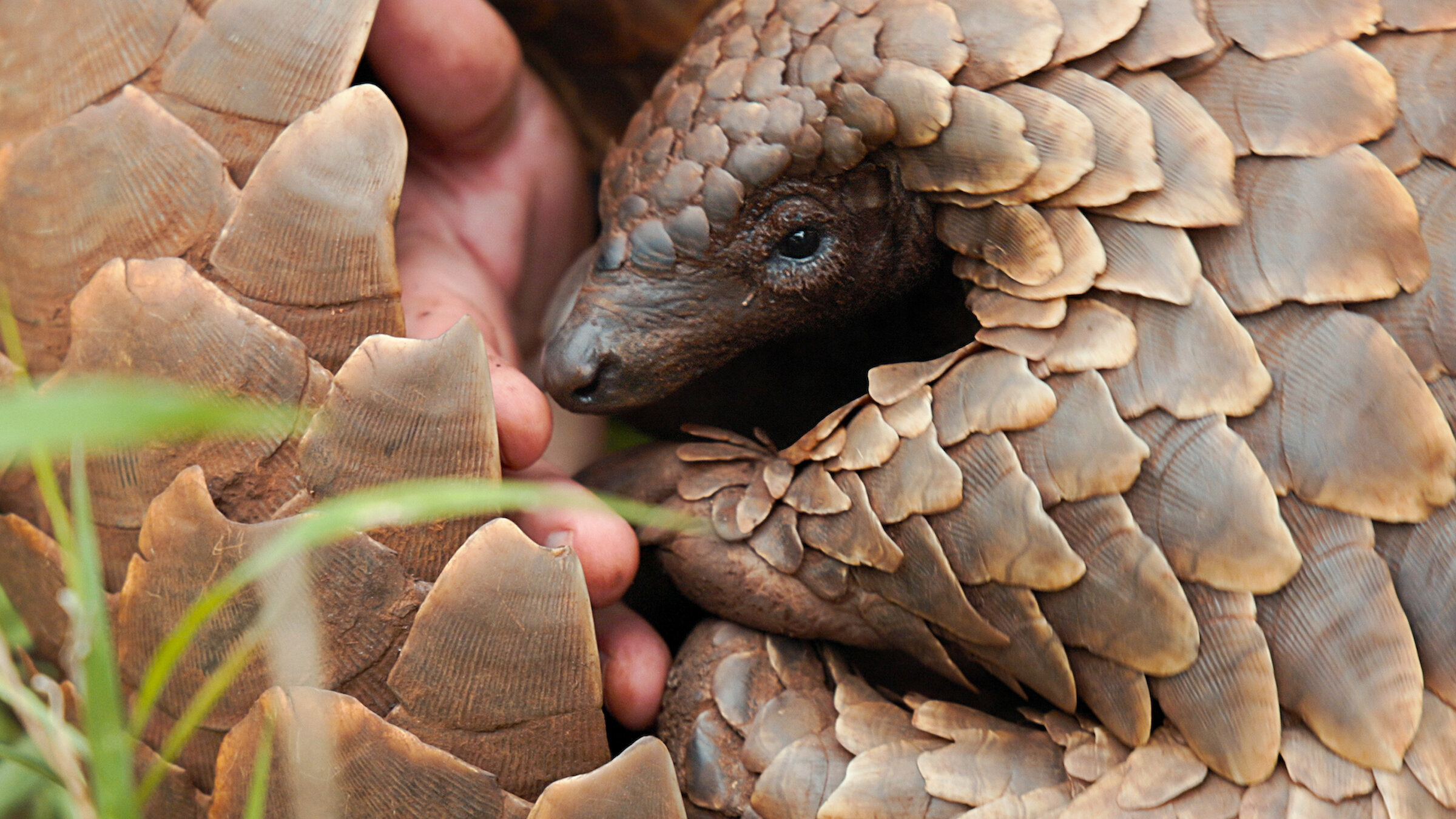
This is the point at which I will reveal to you, for your own sake, that we do not have to endure Kulu or Gareth mauled by lions. So, yes, little kids can watch this without tears. As the documentary winds to its end, we feel sad for Gareth that he’ll need to part with Kulu. Kulu has a tracker affixed, but after about a year, Gareth will use telemetry to find Kulu and remove the boxy-little tracker. This is good, because Kulu will start looking for a mate at some point and she may be put off by the affixed thing.
Although Kulu is a wild animal with a well-founded fear of humans, and a loner by nature, don’t be surprised if you see what looks like fondness from Kulu to Gareth, his surrogate parent.
Now, I know that you already know that you should never ever buy any pangolin product, so I’ll just suggest that you read up on these fascinating animals and support their existence by donations to a reputable organization and/or signing petitions for legislation that protects them. Finally, take my advice and do not go wandering about in bear or big cat territory at dusk with just a flashlight –bring along a spotlight, foghorn, industrial-size can of mace and a cage on wheels that you can clamber into if needed. And be careful to not step on any pangolins.
*According to the International Fund for Animal Welfare (IFAW)..
P.S. Click here for more info on pangolins.
P.P.S. Pangolin: Kulu’s Journey was directed by Pippa Ehrlich, who also made the Oscar-winning My Octopus Teacher – Movie Loon
Movie Loon’s Movie Review Shortcut:
Grade: A
Cut to the Chase: Fascinating — a must for nature and animal lovers.
Humor Highlight: Gareth getting stuck in a burrow –temporarily.
Categories
 Movie Loon