
Rustin
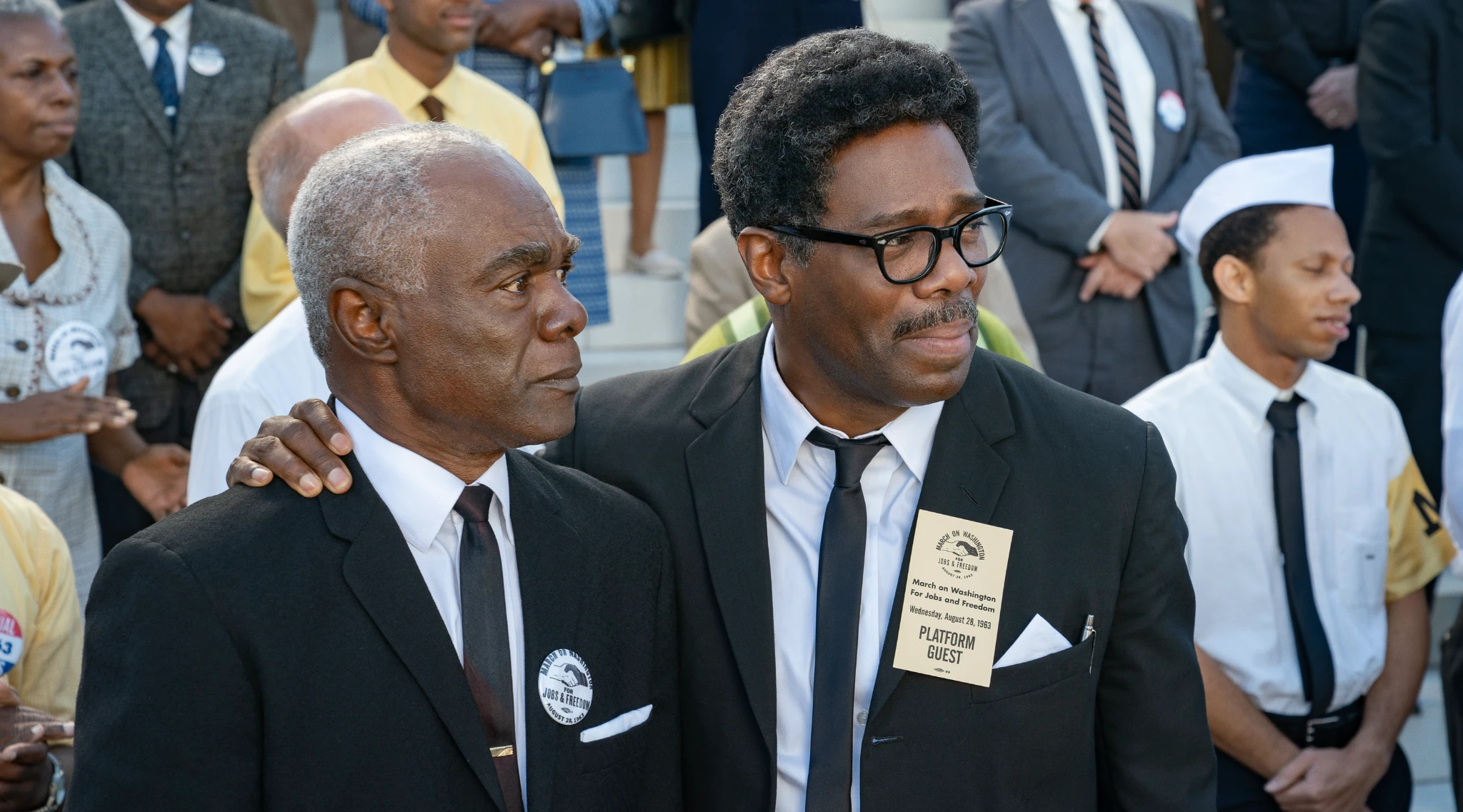
Synopsis: Docudrama on civil rights activist Bayard Rustin and his organization of the 1963 civil rights March on Washington.
Know your civil rights pioneers: Martin Luther King Jr., John Lewis, Rosa Parks, Malcolm X, Ray Wilkins, Thurgood Marshall, Julian Bond, Bayard Rustin–wait, who? Bayard Rustin’s name isn’t in boldface, but his contributions were significant.
Rustin, born in Pennsylvania in 1903, and raised by his grandparents, was a longtime activist before he became the deputy director of the March on Washington in 1963. In the movie, he declares that when he was born Black, he was also born a homosexual. Wow, he understood this even before Lady Gaga sung about it decades later in “Born This Way.” What way? Fabulous!
Rustin’s grandmother was a Quaker and their pacifist teachings would be the foundation of his embrace of nonviolent protest. Gandhi’s political successes with resistance were a motivation for him as well.
In the late 1930’s Rustin moved to NYC to attend the City College of New York. He quickly joined efforts to protest racial discrimination, particularly in the armed forces and in employment.
Rustin focuses on his efforts to organize the March on Washington for Jobs and Freedom. The rally would require a skilled organizer to reach out to Black community organizations, white allies, raise funds and interface with officials in Washington. Two of the film’s producers, Barack and Michelle Obama, know a thing or two about community organizing and making things happen.
Colman Domingo portrays Rustin as a dynamo, eloquent and tireless. He works hard and he plays hard. And he does it with panache. Rustin and fellow activist A. Philip Randolph (Glynn Turman) have their work cut out for them; there are rivalries among the power brokers.
We’re thrown into the deep end in 1960 when Rustin pushes for MLK to stage a rally just before the Democratic National Convention. But! Chris Rock throws a wrench in the works! I mean Chris Rock as Roy Wilkins, director of the NAACP. And Jeffrey Wright of American Fiction! Well, J. Wright as New York Congressman Adam Clayton Powell. They’re both jealous of Rustin’s influence on rising star MLK. Quick skip to 1963…
Never one to wait for a “better” time, Rustin has gone forward with advocating for a two-day March on Washington, reaching out to prominent figures like MLK to speak at the event.
Incidentally, the official program featured twelve speakers, only one of whom was a woman: Daisy Bates, co-publisher of the Arkansas State Press and president of the Arkansas NAACP She was an advocate for school desegregation. She played a major role in advocating for the Little Rock Nine, Black high school students integrating into the local “whites only “public high school. In fact, it was Bayard Rustin who introduced her at the march, before her “Tribute to Women” which was reportedly written by a male staffer. Back to Bayard…

Rustin is enthusiastic in rallying volunteers and coordinating with the top civil rights’ leaders. Of course, with all his work, he needs to wind down on occasion. He goes to parties and dances to music with a drink in his hand. What’s not to like? Okay, now to the reason Rustin was kept behind the scenes…
Rustin was openly gay. To show us how fraught the times were, the movie shows us the lengths that he must go to hide his affair with a married southern preacher, Elias Taylor (Johnny Ramey). I looked Taylor up right away to learn about his life and instead learned that he was a creation of the screenwriters, Julian Breece and Dustin Lance Black. Now you know, so you don’t have to feel like a dummy, thinking you are learning about another forgotten civil rights activist.
No film about the civil rights movement would be complete without at least a cameo of MLK. I’m not familiar with some of the earlier portrayals, but more recent performances have been taken on by Courtney B. Vance and Jeffrey Wright–who is Congressman Powell in this. In fact, Dexter Scott King even played his father in The Rosa Parks Story. Not sure how his reviews were. My favorite MLK is British actor David Oyelowo in Ava DuVernay’s Selma.
Oops, look at me sidelining Bayard Rustin. Colman Domingo keeps us focused; he’s riveting in the role whether he’s teary over romantic disappointment or positively riled up leading his young volunteers.
Because of this, that and the other, it’s decided that the march will be just one day. Rustin meets will national park officials, who oversee the National Mall, and they try to stonewall him. He doesn’t put up with that! Using verbal dexterity, and irrefutable logic, he gets what he needs from the unsmiling white guys.
History tells us that the March on Washington happened so there’s no suspense there. I was eager to see how they’d splice footage of the actual event with tight shots of the actors as civil rights heroes up on the rostrum. Da’Vine Joy Randolph (The Holdovers) appears as the gospel singer Mahalia Jackson who enjoins King to tell the crowd about his dream. I’m glad that he knew she meant his figurative dream of equality and not some actual dream about floating through space on a giant flower or some other weird scenario.
I have to say that I was concerned for the actual marchers of yore what with everyone jammed in together on the mall. For example, how do you get to a restroom? What happens when you run out of snacks and water?
And why, dear God, did they hold the march in August?! Summer in DC is hot and humid as hell. Hmm… the U.S. Weather Service reported that August 28, 1963 was more humid than usual, and topped out at 84 degrees. Believe me, if I could transport myself back in time, I would’ve needed to loll in the reflecting pool while listening to King’s historic “I Have a Dream” speech.
By the end of Rustin, you’ll be well-versed in the power brokers of the civil rights movement. You might feel a little chastened if you didn’t know about Rustin. Instead, be proud that you know about him now; that’s how Michelle and Barack would like you to feel.
Go ahead and continue your civil rights history education by watching Selma, about MLK’s march in Alabama. Colman Domingo is in this movie too, portraying pastor and civil rights activist Ralph Abernathy, not Bayard Rustin. Ruben Santiago-Hudson plays Rustin in this production.
If any production does color-blind casting for civil rights docudramas, I will be really confused. Although I bet Mr. Domingo could do a helluva job as President Kennedy.
P.S. The March on Washington brought 250,000 participants to DC. Massive efforts by Black leaders led to the Civil Rights Act being signed into law by President Johnson on July 2, 1964, after being passed by Congress. It prohibited discrimination in public places and in employment. In 1968, further civil rights legislation was passed following the assassination of King, prohibiting discrimination in housing.
P.P.S. Bayard Rustin died (from a perforated appendix) in 1987. He was posthumously awarded the Medal of Freedom in 2013. The civilian award was presented by President Obama to Rustin’s longtime partner, Walter Naegle.
 Movie Loon