
Blitz

Synopsis: During the Blitz in WWII London, a mother tries to get her son evacuated and survive the bombings herself. (Streaming on Apple TV +)
Sometimes a mother just can’t catch a break. Maybe mom packs an apple with her child’s lunch. But the kid huffily tosses the apple out because they wanted candy. Or maybe the city the kid lives in is being bombed, so mum arranges for her child to be evacuated. Then, before getting on the train out to the countryside, the kid lets mother know what he thinks of her evacuation idea: I hate you!
Such is the lot of Rita, a Londoner during World War II. She’s a single mum, raising her nine-year-old son, George, with help from her dad.
It’s September 1940 and Britain and Germany are at war, after Germany invaded Poland, a British ally. Since July, the Luftwaffe (German Air Force) had been battling the Royal Air Force across the English Channel. In September, the Nazis unleashed a Blitzkrieg, or Lightning War, against the United Kingdom.
Germany began a heavy bombing campaign against UK factories, port sides, shipping lanes and air strips. Bombings weren’t precisely targeted but were ‘area’ bombings that included residential locales. London was particularly hard-hit because of factories stacked up in its East End.
Beginning in September, London would suffer through fifty-six consecutive days of bombings. Initially, attacks were during the day, but the Luftwaffe switched to overnight bombings, as English civil defence sightings were compromised by darkness.
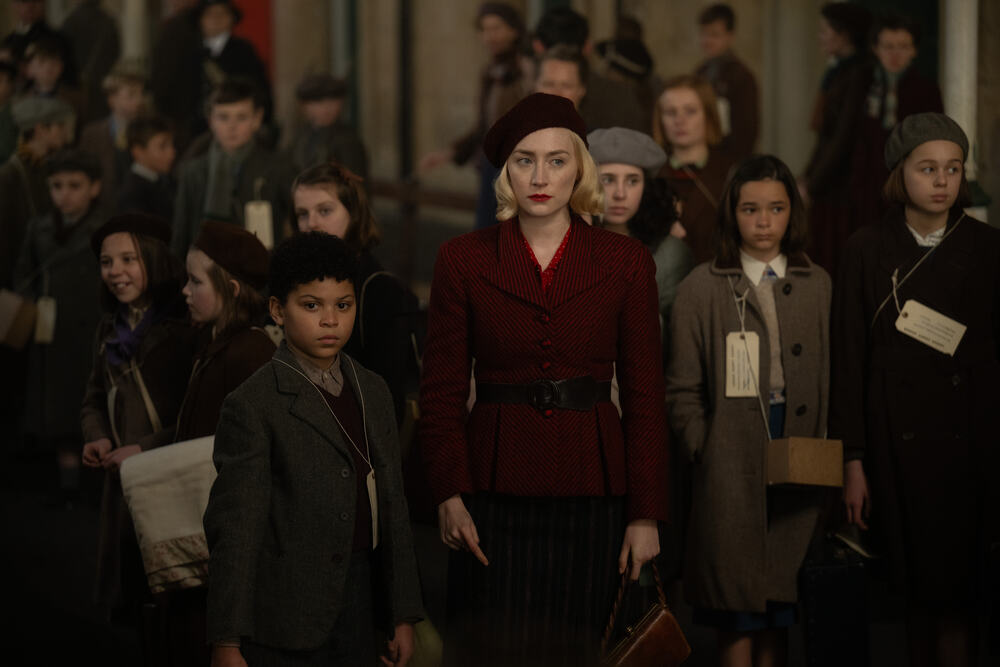
Parents, once reluctant to send their children outside of the city, were now registering for evacuations organized by the Women’s Voluntary Services for Civil Defence.
Blitz is a departure from usual WWII movies that depict soldier experiences and/or lovers torn apart by war. Christopher Nolan’s Dunkirk (2017) stands out as one of the 21st Century’s best ‘soldier’ WWII movies. And Saoirse Ronan stars in one of the best ‘lovers’ movies, Atonement (2007).
Ms. Ronan gives another excellent performance in Blitz. Her Rita works in one of London’s materiel factories, whose war equipment is keeping Germany at bay. Her nine-year-old son George is biracial, his father is Black. Elliot Heffernan plays the child who has to navigate a majority white and conservative society; readily conveying quicksilver emotions and thoughts.
One pre-war flashback shows a plucky George playing ball on the street with neighborhood boys. Added to the usual sport trash talk, one kid spits out a racial slur to George, calling him a ‘black bastard.’ Stunned, he heads home to his mum and grandad, his head hung low.
Fortunately, his mum and grandad Gerald are kind. Rita tries to keep up his spirits with playfulness while grandad, often playing the piano in the parlor, engages the little family in singalongs. Paul Weller of the heralded late 70’s band the Jam plays grandad, so you know that the musicianship is worth a listen. I was hoping he’d play his former band’s standout, “Town Called Malice.” Instead, we get the popular music of the time.
Gerald has passed down his gift to daughter Rita. She takes every opportunity to sing, whether it be at home, the factory or the underground station. In flashbacks, we see her when she and George’s dad were a couple, having a grand time dancing at a club. Not surprisingly, they encounter people who angrily disapprove of their interracial relationship. As it turns out, there were some religious and racial conflicts in shelters. It seems that citizens’ Blitz Spirit wavered from time to time.
Early in the war, officials didn’t open up the underground as shelters. One of the reasons given was that Londoners might refuse to leave the stations. Right… those troublesome civilians trying to stay alive, the nerve!
Deep-level shelters couldn’t meet demand, so authorities relented and opened tube stations. Administrators endeavored to provide basic necessities, including food and refreshment. Even entertainment! Hopefully there was tea to drink and celebrity rags to read. You know, the things the British need to stay sane.
We understand that George would rather grab his pillow and queue up –something the British are very good at — and overnight at the station. But his mum insists he must leave for his own safety.
After his grandad tells him to take no guff from bullies, his mum anxiously gets him to the station for evacuation. Just before boarding the train George tells Rita that he hates her. She begins to cry, but George stays mad as he gets on the train.
Later, working at the factory, Rita is sad. Thankfully she’s not so distracted that she inadvertently blows up her workspace. Invited out for a drink at the end of her shift by coworkers, she tags along. Visibly downcast at the bar, our heroine stands out in a sea of sepia, with her fair skin and red lippie. No wonder neighborhood civil defence worker, Jack (Harris Dickinson) has a crush on her. He steals longing looks at her from across the room, and then readies himself to punch some local bastard who makes a joke about Rita’s son.
George makes a friend on the train, with its countryside-bound children. She’s quite nice but George is quiet. Some guy walks through their car telling the kids to behave, or else. He’s never seen again. Great supervision.
A few boys are emboldened to bully George, but he remembers what grandad said about standing up for himself. He throws them from the train! Just kidding, but George does confront the little brats, saying he’ll fight them if they don’t leave him alone.
I don’t know if George is feeling badly about how he treated his mum or if he has an intuition that things can only get worse, but he decides he needs to get off the train and make his way back to London.
Now, George may be street savvy from growing up in London, but he’s still a kid. He’ll have to be athletic, smart and resourceful to make his way home. He’ll meet helpful people and dangerous sorts. He will have to quickly decide whom to trust.
Meanwhile Rita and her dad are making it through, in spite of the danger and chaos of war. Their kitty is okay too. In fact, in spite of rationing, moggie looks well-fed. I don’t know how my morale would be without chocolate–rationed until 1953!– but there are a couple of essentials that the government made sure that citizens had. For one, beer was never rationed. And, in 1942, Britain bought up all the tea available IN THE WORLD. These things are important for morale.
Early on in Blitz, I was thinking, at least Rita can rest a bit easier knowing that George is safe in the countryside with his assigned guardian. Well, until she finds out that her child never arrived at his destination. The children in his train car share with authorities that George jumped off the train. It was probably the coolest thing they’d ever seen.
It’s non-stop suspense as we follow George and Rita. George only has one sandwich, so that’s his first problem. And no map. Before you know it, things get Dickensian for the poor little waif. And then there’s the racism. Exhausted and lost, he stops in front of a shop window to watch a toy train traveling over miniature terrain. No loitering! yells a cop at the obviously harmless kid.
And Rita! She’ll stop at nothing to find George. She slags off the authorities who were supposed to look out for her child, then puts her coat on and starts running around the city shouting: George! George where are you?!
Blitz really brings home the terror of civilians in bombing zones and the bravery of people young and old. Also, it should be a lesson to kids to listen to their mums.
P.S. In 1940, London’s population was roughly 9 million people. The Blitz lasted from September 1940 – May 1941. Throughout the UK, more than 43,000 civilians were killed. In June 1941, Germany turned their war efforts eastward to the Soviet Union (present day Russia). Find an account of the London Underground as shelter during the Blitz here.
P.P.S. In September 1939, trains began transporting approximately 800,000 children and more than 500,000 adults out of London and other urban areas into the countryside. The Women’s Voluntary Service provided practical support, including matching mothers and children with available rooms in the countryside. Homeowners were compensated for providing shelter. When months went by without air raids, people began to return home.
France fell to Germany in the summer of 1940 and with Germany successfully moving eastward, evacuations (all voluntary) resumed. Because of the Blitz, Britain saw 1.5 million evacuees flee from urban to rural areas. Some children were well looked after whilst others were neglected or abused. Click here to read recollections of people who were evacuated as children.
Movie Loon Movie Review Shortcuts
Grade: A-
Cut to the Chase: The film includes real life details and historical events (eg., references to infamous subway bombings) while riveting us with the two leads’ performances as mother and child.
Humor Highlight: While young George tries to make his way back to his London flat and reunite with his family, he manages to get on a city bus. He asks a transport matron how to get to his neighborhood. She gives lengthly, rapid fire directions that no one could follow. He just nods along. Me too, kid!
Categories
 Movie Loon