The Zone of Interest
Synopsis: The Nazi commandant of Auschwitz and his family live next door to the concentration camp.
Picture a family situated in sylvan countryside. A prosperous 20th Century family hikes to a nearby lake for a swim and picnic. Father’s career is on the upswing. Mother — with the help of servants –raises the five children.
At the lake, the sun burnishes the day of rest. Mother carries baby on her hip while father shepherds the older children. After their fill of recreating, it’s back to their spacious house with its resplendent flower garden. So begins The Zone of Interest.
Father’s job assignment includes the house as a perk. The servants too. His workplace is just beyond the garden fence. He runs a factory. The factory is Auschwitz, its business genocide. The Höss’ are an ideal Nazi family.
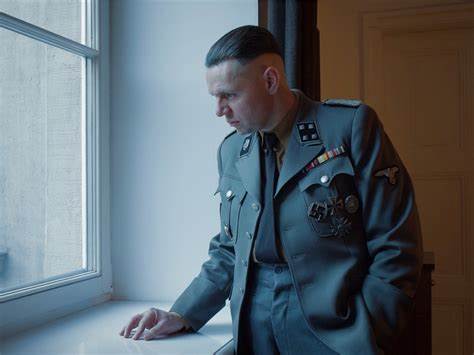
Sandra Hüller portrays mutter, Hedwig and Christian Friedel plays vater, concentration camp commandant Rudolf Höss. It’s the summer of 1943. Auschwitz is in Poland, part of the “living space” that the Germans have claimed in bloody warfare. The family’s house stands in the ‘zone of interest,’ a 9,900 acre area around the camp from which Polish locals have been ejected. The zone of interest, patrolled by German forces, also amounts to a private camp–not the concentration kind of camp– for the family to go horseback riding, hiking and swimming.
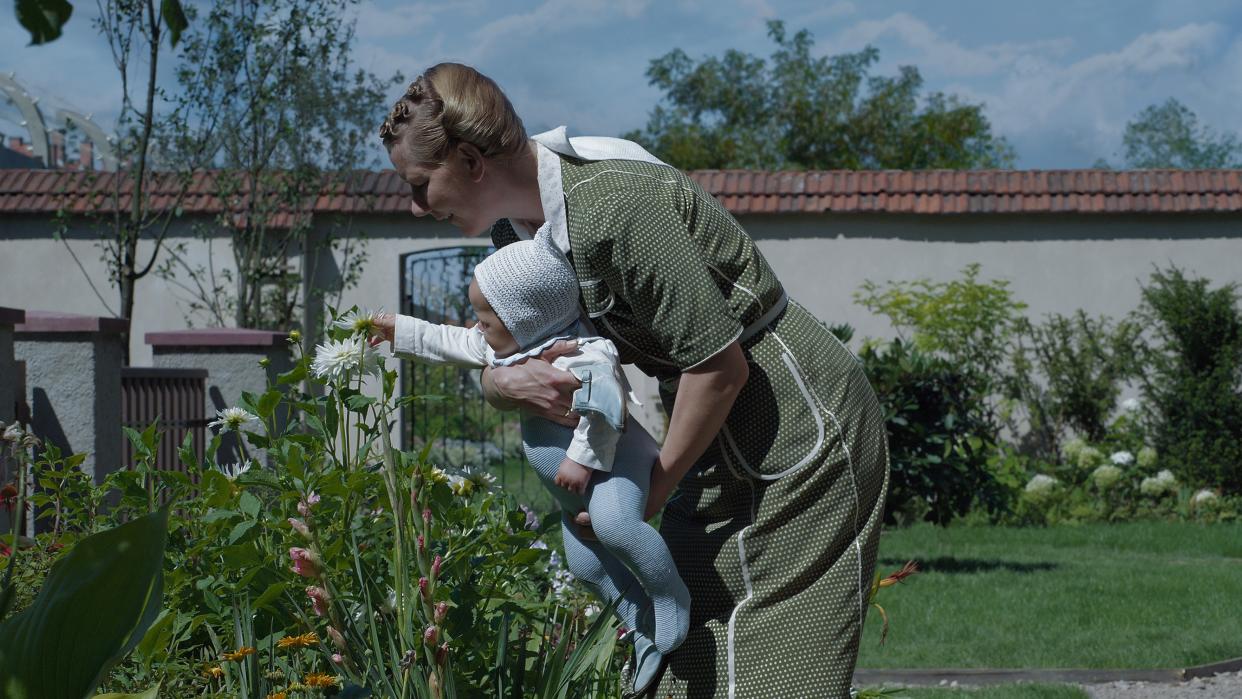
Hedwig is busy efficiently running her household. She takes great pride in her gardens, pointing out the blooming flowers to the baby. Enslaved laborers keep everything tidy.
Life during wartime can be difficult, even for the conquerors. Sure, the German government supplies basics, but what about the luxury items one craves? Fortunately for Hedwig, she has access to Kanada, the warehouse that serves as a sort of department store, stocked with items stolen from incoming prisoners before they are murdered or enslaved for labor. How nice for the hausfrau: jewelry and fur coats. She samples confiscated cosmetics to see if they are flattering on her.
Hedwig can be generous. She summons the non-Jewish household staff to pick from a table of cast-off clothes: shirts, trousers and even children’s clothes. And she only yells at and threatens the Jewish servants when she is mad at her husband. So, what of Rudolf?
On one hand, it’s convenient being close to work. On the other hand, he can’t really get away from work. After dinner, he tries to relax, smoking outside on the stoop. But work is right there! The chimney’s stacks belching out smoke from thousands of burned human bodies.
A mercy for us viewers is that we don’t go into Auschwitz. No matter how well reviewed a movie about the Holocaust is, no one wants to see a depiction of the suffering and terror of people. We watch to bear witness, to activate our sympathy and veer away from the inhumanity. The Zone of Interest builds on what we already know about the horrors of Auschwitz. The filmmaker, director Jonathan Glazer, employs the use of a superb soundscape. We cannot escape the industrial noises of genocide, the routine screams and weeping, the soldiers shouting and shooting. Our mind’s eye fills in the scenes.
We know that scores of children are being murdered beyond the Höss garden walls. But what of the five Höss children? We see them readied for their school days. I wondered where this school for Nazis’ children was located and shook my head, imagining all the lies they are fed. The oldest boy, dressed in a Nazi youth uniform, seems headed down his parents’ extremist path. Otherwise, the children frolic in the garden and splash in a small pool. Fortunately, the baby is too innocent to intuit what is happening at –what do the parents call it? A prison? A workplace for enemies?
Unlike their parents, the children are unable to screen out the intuited horrors next door. One of the daughters seems to have anxiety-induced sleepwalking. The younger son, playing with toy soldiers in his room, can’t block out the prisoners’ desperate pleas and the furious tirades of the soldiers.
At least the family dog seems unperturbed. This is the result, of course, of there being no humans screaming or Alsatian dogs barking on set. In fact, the dog, a black Weimaraner, is Sandra Hüller’s companion. In one interview, comparing her dog with Messi, the border collie dog actor in her film Anatomy of a Fall, Ms. Huller apologizes to her dog for praising the thespian abilities of Messi. “I’m sorry, my darling,” she says, before acknowledging that her dog wouldn’t have been cast in Anatomy of a Fall. Hüller’s dog employed a more naturalistic, do-whatever-I-like approach.
Commandant Höss’ work pressures increase. At a Nazi strategy meeting, he pointedly ignores a colleague’s recent successes. There’s always someone ready to clamber over you on the career ladder! He’s also perturbed by more mundane disturbances, like soldiers denuding flowering shrubs. But he quickly returns to his career objectives; you can almost see the gears turning in his evil Nazi head. How can he murder more Jewish people?
Höss, with his wife’s help, hosts German businessmen who show him plans of an oven and crematory system that can run 24-hours a day. Sadly, he may not see the rotten fruit of his labors. He’s doing such a monstrously good job killing unarmed civilians that he may earn a promotion, overseeing all the death camps. Hedwig is apoplectic. The promotion would move them away from the house and garden she values so much. She blusters at her husband, “You’d have to drag me out of here!” One assumes the irony of millions of people being dragged from their own homes –to be killed– is lost on her.
The Zone of Interest permits us a pinprick of light, of humanity. As Höss reads faerie tales– scary German ones– to his daughters at night, we see an adolescent girl in the zone of interest in the middle of the night. She is filmed with a thermal camera, giving an eerie nuclear winter effect, to her scenes. As Höss’ voice intones the story of Hänsel und Gretel, we see the girl furtively secreting apples into crevices of dirt at construction sites where the laborers will be toiling. The director based the sequences on the memories of a Polish woman named Alexandria who resisted Nazi oppression as an adolescent living just outside the zone of interest. Meanwhile…
Ensuring a high spot in the Evil Monsters of History lists, Höss spearheaded Operation Höss, a plan to kill all of Hungary’s Jewish people. In the summer of 1944, more than 430,000 Jewish Hungarians were murdered at Auschwitz.
Later in the film, we see Höss figuring how he’ll handle of the logistics of speeding up the killing at the concentration camp. So much work! And Hedwig… she’ll have to be brave if her husband’s bosses make him uproot to a garden-less property.
P.S. What are the lessons of The Zone of Interest? Director Jonathan Glazer said that he wanted to demystify the perpetrators of the Holocaust abominations, contradicting our own insistence that their extreme violence was an anomaly.
P.P. S. What is not included in The Zone of Interest; the fate of Rudolf Höss…
Before fleeing approaching Allied forces, Höss and other high-level officers, soldiers and Nazi sympathizers colluded to keep industrialized genocide going, sending trainloads of European Jews to concentration camps where they were murdered in gas chambers, by starvation, untreated disease, hypothermia, beatings, and medical experimentation.
Soviet forces liberated approximately 9,000 people at Auschwitz on January 27, 1945. Most of the Nazis had fled westward, but not before a final flurry of murders. Thousands of still ambulatory prisoners were marched towards other death camps, many dying along the way.
After the war, Höss was captured. He testified at the Nuremburg trials, insisting he was just following orders. (Except, he was a committed Nazi since he joined the party in 1922, supporting the conquering and elimination of people all over Europe.) In an affidavit he confirmed that he was the commandant of Auschwitz and estimated that 2,500,000 people were executed there.
In 1946, Höss was brought to Poland, where he stood trial for his crimes against humanity. He was convicted and sentenced to death. Höss was hanged in April of 1947. On the grounds of Auschwitz.
And so, concludes the story of an ideal Nazi family and how the parents’ embrace of an idiotic and hateful political ideology resulted in nothing good. Except for the garden’s flowers, which were treated much better than the humans across the way.
P.P.S.S. In 2024, The Zone of Interest received Academy Awards for Best International Feature Film (Jonathan Glazer) and Best Sound (Johnnie Burn & Tarn Willers). The film was also awarded the Grand Prix at Cannes (2023) and the BAFTA Award for Outstanding British Film and Best Film Not in the English Language (2024).
Movie Loon’s Movie Review Shortcut:
Grade: A
Cut to the Chase: Groundbreaking. The leads, Sandra Hüller and Christian Friedel, are exceptional.
Humor Highlight: Really?! Okay, the swastika ice sculpture at a Nazi party is ludicrous.
Categories
 Movie Loon