Maestro

Synopsis: An examination of composer-conductor Leonard Bernstein’s work and marriage to Felicia Montealegre. (In theaters and streaming on Netflix as of December 2023)
Maestro, featuring Bradley Cooper as 20th Century composer and big-time celebrity Leonard Bernstein shines a spotlight on Bernstein’s long-term marriage to actor Felicia Montealegre. And wow, does the subject hog the spotlight. Yes, I know it’s a bio pic, but the movie could be re-named Bradley Cooper Goes for All the Awards! Hello, Oscar Bait.
The subject of Maestro, Leonard Bernstein was a giant of the 20th Century music scene. This was especially in the U.S., where he was the first American conductor of note. While Bernstein composed just three symphonies –compared to say, Dmitri Shostakovich’s fifteen– he made his mark in popular music. Bernstein composed West Side Story.
Maestro begins with Bradley Cooper in old man makeup, playing the piano. Then we are whisked back in time where everything is in black and white. It’s 1943 and twenty -five-year-old Bernstein is the assistant conductor for the New York Philharmonic. At the time, performances were at Carnegie Hall. And he has an apartment in the building — so jealous. The locale comes in handy, because one morning, as he’s lolling around in bed with his lover, musician David Oppenheim (Matt Bomer) he gets The Call. That night’s guest conductor has taken ill, and Bernstein needs to fill-in (without a rehearsal). Thankfully, he’s full of talent and confidence. He bounds out of bed, drums on his bf’s butt and flies downstairs in his jams. That night, he’s amazing. Celebrity ensues.
Now, remember, nothing is going to upstage Bradley’s performance. Uh, 1943? Wasn’t there something kinda big going on then? Yes, the movie Casablanca was a big hit. Also, World War II.
Perhaps, we could’ve seen Lenny at his draft physical, where he was disqualified for service because of his asthma. Or at least a street scene of him shaking his head sadly while reading the newspaper headlines. No! We need to concentrate on Maestro, and only Maestro.
The film continues in black and white, inviting us to a party in 1946 where a garrulous Lenny meets his future wife, Felicia Montealegre (Carey Mulligan). She’s a theater actress who will soon make her Broadway debut. Lenny and Felicia engage in flirty banter. They quickly embark on a love affair. Oh, and, for those keeping score: the Allies defeated Nazi Germany and Japan the year before.
Lenny seems happy; at one point he declares, “I love people. I love music.” Part of his happiness might be his due to being untroubled by others’ sensitivities. Blissed out in his new relationship to Felicia, he makes a point of introducing her to his past (concurrent?) love, David. Ouch says David’s face while Lenny beams looks between his current and ex paramours. Tone deaf much, Maestro?
Felicia, not being a naif, learns or intuits that Lenny is gay. That’s okay with her. In fact, she lets him know that she believes they could have a happy marriage while he indulges himself with extramarital sex. Discreetly.
Doing research into both of these accomplished and interesting people, I learned that they got engaged and broke up. Subsequently, she had a several years relationship with actor Richard Hart until he died in 1951. She married Bernstein the same year. You won’t see that in the movie. Concentrate on Bernstein. And… the film goes to color.
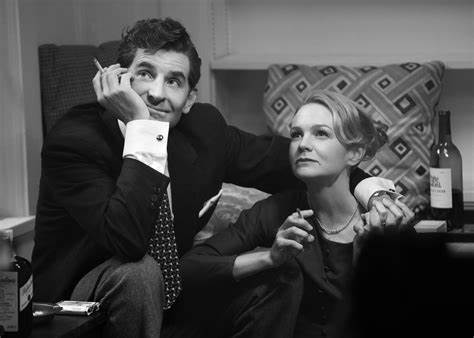
Bam! It’s the late 1960’s/early 70’s. Hey, I said to myself, what’s Maya Hawke doing at that big party? Alas, she is the teenage daughter of Lenny & Felicia. Carey Mulligan looks the same, but Bradley now has grey in his wig and his aging-man makeup goes better with his fake nose. I feel like the filmmakers should have just dispensed with the prosthetic nose. I mean, are 2023 audiences so well-acquainted with his visage that they would reject an actor without a sizable nose?
But then I remembered the whole Oscar bait thing. Nicole Kidman as novelist Virginia Woolf in The Hours. The author wrote most of her important works in the late 1920’s. Her looks aren’t well-known to contemporary audiences, but Kidman wore a prosthetic nose for a better likeness. I guess it does stop your brain from registering this is Nicole Kidman. She won an Oscar for the depiction. So, putting two and two together: good-looking, well-known actor plus prosthetic nose points to Oscar!
As the decades unspool, Bernstein’s career is going gangbusters. All of Lenny’s works are depicted as unalloyed successes. And his profile is high, helped along by international appearances and his television series Young People’s Concerts. I didn’t know anything about the series until Tár. Remember Cate Blanchett as the (fictional) talented and unhinged conductor? Her character claimed to be a protege of Berstein and when she goes off the rails, she takes to watching old tapes of the series.
Lenny and Felicia’s marriage? Not so good. Felicia is hurt by his inattentions and bold indiscretions. I could def see how finding your partner making out with someone at your house party would be disheartening. On one occasion, he brings a new boyfriend, Tommy Cothran (Gideon Glick), to the family home for the weekend. He asks Felicia if he’s done something wrong. Afterall, Tommy is close in age to the oldest of their three kids, so good company, right?
Every relationship movie needs a blowup scene, and it better be a doozy if the star is going to be nominated for all the awards. Felicia and Lenny have a fight on Thanksgiving as the Macy’s parade marches by on the street below. Felicia throws accusations centered around his open-secret affair(s). Lenny yells: How dare you! Big Acting. I got the idea pretty early on that she’s not going to stop being in love with him & he’s not going to having sex with other people; which led me to being distracted by the parade’s Snoopy balloon drifting past their windows.
There’s another even better scene that might win Bradley Cooper the Oscar. In 1973, Bernstein conducted the London Symphony Orchestra at Ely Cathedral in Cambridgeshire. In Maestro, Cooper gives a bravura performance, with six uninterrupted minutes of conducting Gustav Mahler’s ‘Resurrection’. The scene is worthwhile, not only for the opportunity to do some Big Acting, but because Bernstein identified with the composer-conductor. Berstein explained it as a predicament , “like being a double man.”
Which brings us back to his marriage. Lenny has spent his life living exuberantly, as a person with big appetites. He doesn’t stop working or pursuing pleasure. He’s onboard with one of the biggest 20th Century addictions, nicotine. And there is a constant swirl of smoke around just about every social gathering. Oh, and Carey Mulligan uses a cig very effectively when she’s arguing with Lenny, pointing accusingly at him with a glowing cigarette to add a little menace. Maybe Carey will get award nominations too!
Bernstein drinks. A lot. Some biographers call him an alcoholic. In one scene, we see him partying in old age with young people at a disco. And busy Lenny keeps up an active love life. Felicia, in an old letter, identifies him as a homosexual. Would Bernstein describe himself as gay or bi, pan or no label at all?
Felicia and Lenny’s marriage wasn’t conventional. And, for much of the film, you wonder if his pursuit of romance and sex outside his marriage signaled a lack of feeling for her. After all, there was always the chance that she couldn’t be ‘the one’ if he could find the right man.
But then fate intervenes, and Lenny has a choice to make about his needs vs hers. By the end of the film, late in his life, questions are answered about what his depth of feeling for Felicia was. But his legacy in music? Well, if you read music scholars’ opinions on great composers of the 20th Century–the reviews are mixed. But his contributions to music, across a wide board, were considerable.
And if Bradley Cooper’s interpretation of Leonard Bernstein– how he lived his life and his apprehension of art– is accurate, he’s a figure worth knowing. And someone worth making a big movie about. And worth wearing a prosthetic nose for.
P.S. Phenomenal makeup by Kazu Hiro, seamless. Trompe l’oeil best describes his ability to mimic the hollowing out a face acquires in old age. Some of the films featuring his work are Darkest Hour (transforming Gary Oldman into Winston Churchill) and Bombshell (making over Charlize Theron into American broadcaster Meghan Kelly).
P.P.S. The internet tells me that Mozart, Bach and Beethoven are the most significant classical composers. An incomplete compendium of acclaimed 20th Century composers includes: Samuel Barber, Béla Bartok, Aaron Copland, Claude Debussy, Edward Elgar, George Gershwin, Sergei Prokiev, Sergei Rachmaninoff, Camille Saint-Saëns, Dmitri Shostakovich & Ralph Vaughn Williams.
P.P.S.S. Cinema has used symphonic music and opera to great effect in movies such as: Mascagni’s Cavalleria Rusticana in Raging Bull, Strauss’ Also Sprach Zarathustra in 2001: A Space Odyssey, Smetana’s Moldau in the Tree of Life, Beethoven’s Symphony No. 7 in The King’s Speech, Puccini’s aria “O mio babbino caro” in A Room with A View and Trent Reznor & Atticus Ross’ re-work of Edvard Grieg’s In the Hall of the Mountain King in The Social Network.
Movie Loon’s Movie Review Shortcut:
Grade: B
Cut to the Chase: Good– not great– biopic with fantastic performances by Bradley Cooper and Carey Mulligan
Humor Highlight: The audience knows that Lenny is still catting around when he shows up for rehearsal in a spiffy ascot, striped Gallic-influenced striped sailor shirt and Mephistopheles-on-the -prowl facial hair.
Categories
 Movie Loon