
Killers of the Flower Moon
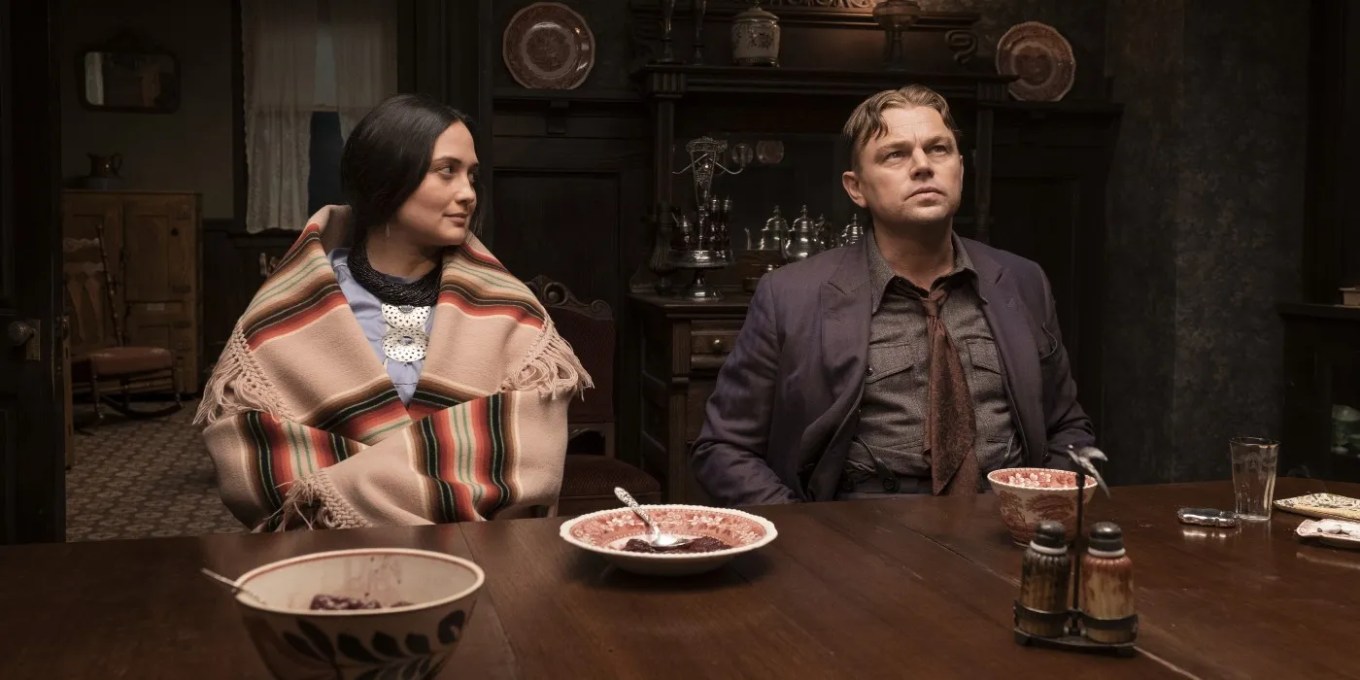
Synopsis: Native Americans in 1920’s Oklahoma are being murdered for their oil rights. (In theaters as of October 2023.)
Killers of the Flower Moon is a tour de force, albeit slightly compromised by too much focus on boosting screen time for a particular actor…
The film is based on the superb non-fiction book of the same name. The book turned out to be a blockbuster, but the publisher couldn’t have known how it would take off. Therefore, the book was saddled with a clunky subtitle that reads thusly: The Osage Murders and the Birth of the FBI.
The book investigates dozens of murders of Osage tribe members in early 1920’s Oklahoma. A little background… the Osage once ranged through the American Midwest, roughly from Ohio to Missouri. Pushed westward by white settlement, the Osage Nation Reservation (totaling more than one million acres) was established circa 1883 in what would become the state of Oklahoma. Oil was discovered on their land in 1897. In 1906, an act of Congress assigned each of the 2,229 tribal members an equal allotment of surface rights. The property rights are called “headrights.” The Osage were required to have white guardians oversee their spending from any revenue. Also, non-Indians could marry Osage and inherit property rights. You’ll want to remember this because, in the movie, one white character keeps telling another that they have to get the Indian headrights at all costs.
Martin Scorsese helmed the production; directing, of course, and co-writing the screenplay with Eric Roth. Scorsese wisely brought Leo DiCaprio onboard and consulted with Osage representatives. Lucky for us, he shot on location in Oklahoma. No green screen here– real prairie grasses, real Western skies!
The book is written like a mystery, looking at multiple possible killers. But the film concentrates on one suspect, a local rancher who endeavors to scam Osage out of their money one way or another. The rancher is William King Hale, portrayed by Robert DeNiro. He alternately sweet talks and threatens. And when he’s mad, he has DeNiro’s patented gangster scowl.
Leo was going to play a hero, a federal agent who arrives late on the scene to solve the murders. But he wanted and got (just like Meryl Streep gets what she wants) the role of Ernest Burkhart, the nephew of the rancher-mobster hybrid played by DeNiro. In the three plus hours of running time, we’ll see his uncle’s sway over him and his occasional resistance. Will he be a hero? Well, that’s what his on-screen love interest will want to know…
After time spent serving in the army and eking out a living around America, Ernest returns to Oklahoma to work for his rancher uncle, King. His brother, a real piece of s**t, already works for King. Even though the guy runs a cattle ranch, you never see him doing anything related to tending his business. This is because he is always plotting and planning to screw the Indians out of their money. King refers to them as friends and makes a big show of greeting them in their Siouan language. He’s absolutely a wolf in sheep’s clothing (which would be woolen fleece, I suppose).
< from here in let’s just call the actors by their real names– it helps me picture them in all their finery>
It’s clear from the outset that Leo is dumb and greedy. Well, his character, anyway. When DeNiro is interviewing Leo for what kind of flunky job to assign his nephew, he is thinking of how to use him in his rob-the -Indians scheme. DeNiro asks if he likes women. Leo chuckles nervously and says: You know I like women. That’s my weakness. Yes, we know! Fortunately, this movie’s Leo doesn’t relegate his dating to twenty-year-old models, because his uncle wants him to court a single Osage woman in her mid-thirties. You’ll see what a good actor Leo is when he has to flirt with this non-model woman.

Leo sets to work as a proto Uber driver, hanging around town to see if he can pick up said woman, Mollie Kyle from her errands. Lily Gladstone is excellent as Mollie; you can’t take your eyes off her performance. When Leo manages to snag her as a passenger, he works his tail off to charm her. Lily/Mollie grins and says: Coyote wants money. Still, she invites him to dinner. The wealthy woman figures Ernest is an opportunist but thinks he’s cute. (Can I say something about Leo? I really have to give him credit for not becoming part of the Marvel or DC Universe. Marty was right, these movies are crowding real cinema out of theaters.)
While Leo is courting Lily/Mollie, following DeNiro’s plan to marry her and share in the oil spoils, he’s also masking up and robbing people with his brother, Byron (Scott Shepherd). Leo figures he’ll strike it rich gambling –he’s already giggled to DeNiro about how much he loves money. This shiftless ne’er-do-well plays cards. Badly. Too bad he didn’t try an honest night’s work, like Door Dashing vittles to the townsfolk.
One night, Lily/Mollie asks Leo if he is afraid of DeNiro. He says ‘no.’ (A lie.) He goes on to say that DeNiro is ‘nice.’ (Also, a lie.) We have scene after scene of DeNiro badgering Leo about getting the headrights into their family. Dumb Leo keeps trying to contract out to have people who might be onto their plot beaten up. But he sucks at, well…thinking. So, DeNiro yells at him, yanks him along by the ear and paddles him. Yes, paddling. Like some Old West version of hazing.
DeNiro does not help the movie. Scorsese has reported that he wanted to make Ernest and Mollie the center of the story, but he doesn’t! Instead, it’s like Scorsese and DeNiro made a compact, giving the actor as much screen time as Leo and maximization of closeups when he scowls. By the time DeNiro was showboating at a picnic, speaking to the Osage in their language, proclaiming undying friendship, I’d had enough.
While DeNiro takes out life insurance policies on his Indian ‘friends’ who owe him money, Leo’s relationship with Mollie progresses. But he has a thorn in his side: Bill Smith, Mollie’s brother-in-law. On behalf of his wife, he’s been asking too many questions. Leo pays him a visit, frowning and posturing, looking to intimidate him into silence. But Mr. Smith stays cool as a cucumber while Leo blusters and stalks around the man’s parlor. I was rooting for the brother-in-law because he was out for justice and ably played by the great singer-songwriter, Jason Isbell. (Jason is from Alabama, so he was already on the right road to segue into a southern rural character.) I was so hoping he’d sing! His Americana music would be perfect for a ditty or two at the picnic where DeNiro is monologuing forever. Drown him out with some good music, Jason!
Leo makes the most of his screen time, mostly trying to insinuate himself with his uncle and wife, who have opposing aims: the former wants her dead and the latter wants to live.
Lily/Mollie goes to a meeting of Osage and some white area residents to discuss what to do about the killings. Leo tries to look concerned, but also convey that it’ll blow over. Lily/Mollie favors sending a representative to Washington to plead for help. An Osage elder laments that the whites “walk around like they own the place.” I think I caught one line about genocide. Yes, genocidal policies against Natives were pursued by the government and abetted by white invaders. But the term genocide* didn’t exist until 1944, when it was coined by a Jewish Polish lawyer, Raphael Lemkin, in reference to the Holocaust.
From day to day, Leo tries to divert his partner’s attentions from her inquiries. He acts solicitous, reassuring her of his love and insisting she look after her health. (Remember how sincere Leo was in Titanic, when he was with Rose? <Sob>) Lily/Mollie has diabetes and Leo hollers at her to take her insulin (a new medicine) and snitches to her doctor that she recently had bacon and taffy. Not my cheat day preferences, but to each their own.
The thing that struck me the most in the book, is how easily some white men went ahead and killed Indians with whom they had been friendly for years, on the chance they’d get some cash. In the movie, one man who is offered a murder-for-hire “job,” says he’s not a killer. After learning the target, he perks up and declares: Well, an Indian! That’s different. Dear God…
Dozens of Osage were killed during what the Natives came to call the Reign of Terror. Local law enforcement was turning a blind eye to the suspicious deaths. It’s clear that someone from outside the region is going to need to step in.
One afternoon, Lily/Mollie awakes from a fever dream. She has some old-timey affliction referred to as ‘wasting disease.’ (The strides in medicine would have to wait ’til midcentury.) She cries out; and laggard Leo ambles into her bedroom. He reassures Lily/Mollie, telling her to rest and think good thoughts. He practically whispers in her ear: Good thoughts about signing away all your oil money rights to me.
Instead of this Osage woman recounting a dream of an owl telling her that her time is nigh (in legend, owls come by to tell a person who’s about to die to metaphorically pack their bags), she reveals to Leo that a man in a hat is coming. (Not the man in the yellow hat known to Curious George, the monkey. Those characters hadn’t been created yet.) Lo and behold, the hatted man arrives in town … Jesse Plemons. He’s so fantastic– you know him from The Power of the Dog and Black Mirror. (Also, he’s married to fellow talented actor, Kirsten Dunst.) He takes on the role Leo was originally set to play: federal agent Tom White. Jesse P’s portrayal conveys the man’s quiet authority and piercing mind as he methodically pieces together evidence.
Also assigned to the investigation is federal agent John Wren, who cuts an intriguing figure. He’s portrayed by Tatanka Means, son of the late esteemed Lakota activist, Russell Means who movingly played opposite Daniel Day-Lewis in The Last of the Mohicans as Chingachgook.
Things are about to get more complicated for DeNiro and Leo. So… will Leo override his fear of DeNiro and his own greed? Does he even love Lily/Mollie? After three hours, you’ll learn if the coyote is, in fact, a snake.
P.S. Some Osage History…. Traditionally, the Osage were part of the Mississippian culture. As white colonization pushed Iroquois Nation tribes westward in the 1700s, warfare ensued with the Osage, resulting in their inhabitation west of the Mississippi. They were a dominant presence in the Plains by the mid-1700’s, traveling by horse and hunting bison. They clashed with Kiowa, Comanche and the Cherokee who were forced westward (the Trail of Tears) from the southeastern U.S. by the 1830 Indian Removal Act. Over time, treaties with the US saw the Osage conceding to western reservation lands in exchange for food and supplies. The first reservation of Osage was in Kansas, where a smallpox epidemic nearly halved their population. During the American Civil War and the 1870’s depression (when food supplies agreed to in treaties was not delivered by the US government) famine was widespread. In 1879, an Osage delegation went to Washington DC to secure cash payments instead of supplies. A few years later, they purchased land from the Cherokee and established the Osage Nation Reservation in Indian Territory (present-day Oklahoma). Shortly, thereafter, the Dawes Act of 1887 broke up reservation lands into allotments. This served to destroy a communal way of life for Native peoples. Among other things, the act did not allow Native women to receive an allotment until they were married. (Note that Mollie Burkhart had been married before the action in the movie begins.) In 1925, Congress prohibited non-Osage from inheriting headrights. As of 2020, the Osage Nation numbers roughly 20,000 people.
* What is genocide? There are several components to classify action/s as genocidal. The aim of destroying a national, racial, religious or ethnic group is pursued by the following methods: killing…causing serious bodily or mental harm…inflicting group conditions to bring about the destruction of the group…intent to prevent births…forcible transfer of children. (It seems, in the interest of encouraging humanist values and critical thought, that high school students’ social studies could research where the term genocide applies to various events, past and present, in the world. But I wonder what states or nations would include such coursework.)
Movie Loon’s Movie Review Shortcut:
Grade: A-
Cut to the Chase: If there were more Leo & Lily and less DeNiro, I’d call this Scorsese’s finest film.
Humor Highlight: The relentlessly mugging DeNiro. See him in The Godfather Part II (1974) and Silver Linings Playbook (2012) for his best performances.
Categories
 Movie Loon